

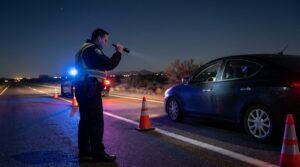
Arizona DUI Checkpoints: What Drivers Need to Know in 2026
If you have ever driven through a sobriety checkpoint in Arizona and wondered whether it was legal, you are not alone. The short answer is yes, DUI checkpoints are legal in Arizona and have been upheld by federal and state courts for decades. However, not every checkpoint is automatically lawful, and you have rights when encountering one. Understanding the legal framework behind sobriety checkpoints can help you protect yourself if you are stopped, arrested, or charged with a DUI.
If you were recently stopped at a checkpoint and are facing a DUI charge, time is critical. Reach out to Suzuki Law by calling 602-682-5270 or contact us today to discuss your options.

Are DUI Checkpoints Legal in Arizona Under the Constitution?
Yes, DUI checkpoints are legal in Arizona when law enforcement follows established guidelines. The legal foundation traces back to key U.S. Supreme Court decisions, including Michigan Dept. of State Police v. Sitz, United States v. Martinez-Fuerte, and Delaware v. Prouse, which established a balancing test weighing public safety against intrusion on individual rights. Arizona’s Supreme Court addressed this in State v. Superior Court (Simmons), a 1984 case examining whether sobriety checkpoints conducted without individualized suspicion violated the Fourth Amendment.
The court drew a crucial distinction between fixed checkpoints and roving patrols. Fixed checkpoints, where every vehicle is stopped or a neutral formula is used systematically, are considered less intrusive than roving patrols relying on officer discretion. The court found that the brief, routine nature of checkpoint stops tips the balance in favor of removing impaired drivers from the road. You can review the full opinion in State v. Superior Court for the detailed legal analysis.
The Simmons case demonstrates proper checkpoint procedures. The Tucson Police Department operated under an extensive command directive, stopping vehicles according to a predetermined, neutral plan rather than selective targeting. This satisfied constitutional requirements. However, in State ex rel. Ekstrom v. Justice Court, the Arizona Supreme Court struck down DPS roadblocks where officers had excessive discretion and the state could not demonstrate effectiveness, illustrating that not all checkpoints pass constitutional scrutiny.
???? Pro Tip: If officers appeared to select vehicles randomly or based on subjective criteria rather than stopping every car or following a neutral formula, that inconsistency could form the basis of a constitutional challenge to your stop.
How Arizona Defines and Penalizes DUI Offenses
Arizona law takes a tiered approach to DUI charges, with penalties increasing significantly at higher blood alcohol concentration (BAC) levels. Under A.R.S. § 28-1381, it is unlawful to drive or be in actual physical control of a vehicle while impaired to the slightest degree. Arizona also sets a per se legal BAC limit of 0.08 within two hours of driving for standard drivers and 0.04 for commercial motor vehicle operators under A.R.S. § 28-1381(A)(2) and (A)(4).
A conviction under A.R.S. § 28-1381 is a class 1 misdemeanor. Beyond standard DUI, Arizona recognizes Extreme DUI under A.R.S. § 28-1382(A)(1) for BAC levels of 0.15% or more, and Super Extreme DUI under A.R.S. § 28-1382(A)(2) for BAC levels of 0.20% or higher. Aggravated DUI under A.R.S. § 28-1383 elevates charges to a felony under certain circumstances, such as driving on a suspended license or with a minor in the vehicle.
| DUI Tier | BAC Range | Governing Statute |
|---|---|---|
| Standard DUI | 0.08%, 0.149% | A.R.S. § 28-1381 |
| Extreme DUI | 0.15%, 0.199% | A.R.S. § 28-1382(A)(1) |
| Super Extreme DUI | 0.20% and above | A.R.S. § 28-1382(A)(2) |
| Aggravated DUI | Varies (felony triggers) | A.R.S. § 28-1383 |
| Commercial Vehicle DUI | 0.04% and above | A.R.S. § 28-1381(A)(4) |
???? Pro Tip: If you hold a commercial driver’s license, the lower 0.04% BAC threshold means even a small amount of alcohol could put your livelihood at risk. Speak with an attorney immediately if facing a CDL-related DUI charge.

Arizona’s Implied Consent Law and What Happens If You Refuse Testing
When you operate a motor vehicle in Arizona, you automatically consent to testing for blood alcohol concentration or drug content if arrested for DUI. This is Arizona’s Implied Consent Law under A.R.S. § 28-1321, and refusal carries serious administrative consequences. A first refusal results in a 12-month driver license suspension, and a second or subsequent refusal within 84 months triggers a two-year suspension. These penalties apply regardless of whether you are ultimately convicted of DUI. Even if you refuse, law enforcement may obtain a search warrant to compel a blood draw.
The administrative suspension process is separate from criminal proceedings. The MVD handles license suspension independently, and you have a limited window to request a hearing. Missing that deadline can mean losing driving privileges without any opportunity to contest the suspension. For more guidance on checkpoint encounters, read our guide on sobriety checkpoints in Phoenix.
???? Pro Tip: Mark your calendar immediately after a DUI arrest. Arizona’s administrative hearing deadlines are strict, and missing them may result in automatic license suspension.

Why Arizona Invests Heavily in DUI Checkpoint Enforcement
Arizona has demonstrated strong commitment to DUI enforcement through funding and policy. The Governor’s Office of Highway Safety (GOHS) provides leadership and funding to reduce the threat of DUI drivers. The Arizona Department of Public Safety (DPS) has advocated for intensive sobriety checkpoint programs, estimating such programs would reduce alcohol-related fatalities by at least 15%.
Arizona’s Administrative License Revocation laws have reduced alcohol-related fatalities by an average of 6.5%. The Arizona Department of Public Safety (AzDPS) notes that ‘a well-publicized state law lowering driver BAC limits to.08 can potentially reduce alcohol-related fatalities by an average of 7%.’ Arizona’s Zero Tolerance Law for drivers under 21, which makes it illegal to drive with any detectable amount of alcohol under A.R.S. § 4-244(34), also contributes to statewide enforcement efforts. These tools have contributed to measurable reductions in impaired-driving incidents across the state.
For drivers, this means checkpoints are not going away. Understanding that law enforcement views checkpoints as a cost-effective safety tool helps explain why you are likely to encounter them, particularly during holidays, weekends, and special enforcement campaigns.

Your Rights at a DUI Checkpoint in Arizona
Being stopped at a checkpoint does not mean you have waived your constitutional rights. While the stop itself may be lawful, officers must still develop reasonable suspicion or probable cause before escalating the encounter beyond a brief interaction. You generally have the right to remain silent beyond providing your license and registration, and you have the right to decline field sobriety tests, though refusing a chemical test after arrest triggers Implied Consent penalties.
Every detail of the checkpoint procedure matters from a defense perspective. Courts examine whether supervisory personnel authorized the checkpoint, whether every vehicle was stopped or a neutral formula was used, and whether the stop was brief and minimally intrusive. If law enforcement deviated from these AZ DUI checkpoint laws, your Arizona DUI defense attorney may have grounds to challenge the legality of the stop and seek suppression of evidence.
- Officers must follow a predetermined, neutral plan for stopping vehicles
- The checkpoint location and procedures should be authorized by supervisory personnel
- The duration of each stop should be brief unless officers develop individualized suspicion
- Signage or advance notice of the checkpoint may be relevant to its constitutional validity
???? Pro Tip: If stopped at a checkpoint, remain calm and polite. Note how many cars were being stopped, whether signage was posted, and how long you were detained. These observations can be valuable if you need to challenge the stop.
Challenging the Evidence After a Checkpoint Arrest
A lawful checkpoint stop does not automatically make all evidence gathered admissible. Defense attorneys frequently challenge the accuracy of breath and blood testing equipment, officer qualifications for administering field sobriety tests, and whether proper chain-of-custody procedures were followed. Calibration records, maintenance logs, and the timing of the chemical test relative to driving can all affect BAC result reliability.
Administrative Deadlines You Cannot Afford to Miss
Arizona imposes tight deadlines on drivers who want to contest a license suspension after a DUI arrest. The administrative process through MVD runs on its own timeline, and waiting for your criminal case to resolve can result in losing your license by default. Acting quickly to request a hearing preserves your opportunity to challenge the suspension and may allow restricted driving privileges.
???? Pro Tip: The administrative hearing and the criminal case are two separate proceedings with different deadlines, burdens of proof, and consequences. Address both tracks simultaneously.

Frequently Asked Questions
1. Can I turn around to avoid a DUI checkpoint in Arizona?
Making a legal U-turn or turning onto a side street before reaching a checkpoint is not, by itself, a violation. However, if officers observe a traffic violation during your maneuver or develop reasonable suspicion based on your driving behavior, they may initiate a separate traffic stop.
2. What happens if I refuse a breathalyzer at a checkpoint?
Under Arizona’s Implied Consent Law, refusing a chemical test after a lawful DUI arrest results in an automatic 12-month license suspension for a first refusal and a two-year suspension for subsequent refusals within 84 months. These administrative penalties apply even if you are never convicted of DUI. Law enforcement may also seek a search warrant to obtain a blood sample.
3. Are DUI checkpoints legal in Arizona for commercial drivers?
Yes. Commercial drivers face a lower BAC threshold of 0.04% under A.R.S. § 28-1381(A)(4), and a DUI conviction can have severe consequences for your CDL and career. Checkpoints apply equally to commercial and non-commercial vehicles.
4. Can my attorney challenge the legality of the checkpoint itself?
Yes. If law enforcement failed to follow constitutional requirements, such as using a neutral stopping formula, obtaining supervisory authorization, or keeping the stop brief and minimally intrusive, your attorney may file a motion to suppress evidence. Courts apply the balancing test from Michigan Dept. of State Police v. Sitz, Martinez-Fuerte, and Delaware v. Prouse to evaluate whether the checkpoint was constitutionally conducted.
5. Does Arizona have a zero tolerance policy for underage drivers?
Arizona’s Zero Tolerance Law under A.R.S. § 4-244(34) makes it illegal for any person under 21 to drive with any detectable amount of alcohol in their system. Research on zero tolerance laws nationally has associated such laws with reductions in underage alcohol-related fatal crashes ranging from approximately 10% to 24%.
Protect Your Future After a DUI Checkpoint Stop
DUI checkpoints are a well-established part of Arizona’s impaired-driving enforcement strategy. What matters most after a checkpoint arrest is how quickly and effectively you respond. From challenging the constitutionality of the stop to questioning BAC testing accuracy to meeting critical administrative deadlines, every step you take can shape the outcome of your case.
If you have been stopped or arrested at a DUI checkpoint in Arizona, do not wait. Call Suzuki Law at 602-682-5270 or reach out online to schedule a consultation and start building your defense today.
Call or text (602) 682-5270 or complete a Free Case Evaluation form