


A criminal case can seem like it’s moving at full speed in the beginning. There may be a traffic stop, an arrest, a police report, your first court appearance, and decisions about release conditions, all within a matter of days. Then, just as quickly, everything can feel like it comes to a halt while evidence is reviewed and testing is completed.
Forensic testing can bring a criminal case to a standstill while the parties wait for the results. As of May 31, 2026, the Arizona Department of Public Safety reported 2,176 backlogged drug toxicology cases and an average turnaround time of 108 days.
While every case is different, delays in lab testing can affect when evidence becomes available and how quickly a case moves through the court system. If you’re facing charges and aren’t sure what those delays could mean for your situation, an experienced Phoenix criminal defense lawyer can help you understand the process and protect your rights at every stage.
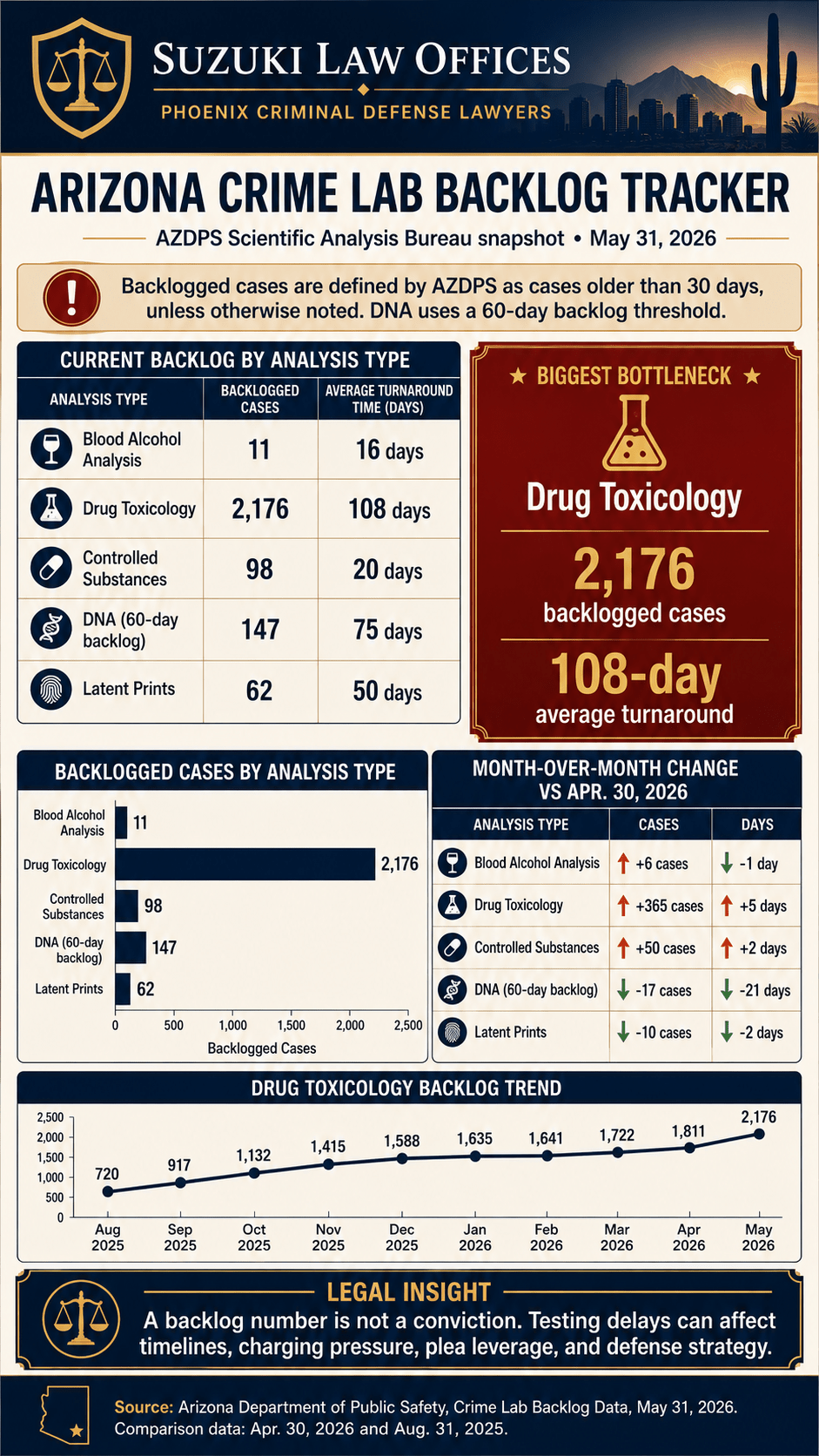
That was the biggest bottleneck among the five public backlog categories reported by AZDPS:
|
Analysis Type |
Backlogged Cases |
Average Turnaround Time |
| Blood Alcohol Analysis | 11 | 16 days |
| Drug Toxicology | 2,176 | 108 days |
| Controlled Substances | 98 | 20 days |
| DNA (60-day backlog) | 147 | 75 days |
| Latent Prints | 62 | 50 days |
For someone facing criminal charges, these numbers represent more than a growing backlog. Delays in lab testing can influence when prosecutors make decisions, how plea negotiations unfold, and when the defense has a complete picture of the evidence.
Just as importantly, a pending lab report doesn’t establish guilt, and even a completed test result should be carefully examined rather than accepted at face value.
What Counts as an Arizona Crime Lab Backlog?
AZDPS defines backlogged cases as cases older than 30 days, unless noted otherwise. DNA uses a 60–day backlog threshold. That means the backlog is not simply a count of every case in the lab. It is a count of cases that have aged past the agency’s backlog marker without a report being released.
AZDPS also reports average turnaround time. This is the average time it takes for the Scientific Analysis Bureau to complete a case from receipt of evidence to release of a report.
These two numbers answer different questions:
|
Metric |
What It Tells You |
| Backlogged cases | How many older pending cases remain without a released report |
| Average turnaround time | How long that type of analysis is taking on average |
| Month-over-month change | Whether the pressure is getting better or worse |
| Trend over time | Whether the delay is isolated or part of a pattern |
That distinction matters because a smaller backlog does not always mean a faster case, and a larger backlog does not always mean every case will be delayed the same way.
Drug Toxicology Is the Biggest Bottleneck
Arizona Department of Public Safety, “May 31, 2026 Crime Lab Backlog Data,” updated June 2, 2026.
AZDPS reported:
|
Drug Toxicology Metric |
May 31, 2026 |
| Backlogged cases | 2,176 |
| Average turnaround time | 108 days |
| Increase from April 30, 2026 | +365 cases |
| Turnaround time change from April 30, 2026 | +5 days |
Drug toxicology represented the largest of the five analysis categories included in the public AZDPS backlog tracker.
By comparison, the Arizona Department of Public Safety reported 11 backlogged blood alcohol analysis cases, 98 controlled substance cases, 147 DNA cases, and 62 latent print cases, while drug toxicology accounted for 2,176 pending cases.
Those delays can have a real impact on certain criminal investigations, particularly DUI drug cases, drugged driving allegations, and cases involving biological evidence.
If you’re facing charges while toxicology testing is still pending, speaking with an experienced Phoenix DUI lawyer can help you understand how those delays may affect your case and what to expect as the legal process moves forward.
The Drug Toxicology Backlog Has Been Rising
The drug toxicology backlog also shows a clear upward pattern across the available AZDPS monthly data.
|
Month |
Drug Toxicology Backlogged Cases |
| August 2025 |
720 |
| September 2025 |
917 |
| October 2025 |
1,132 |
| November 2025 |
1,415 |
| December 2025 |
1,588 |
| January 2026 |
1,635 |
| February 2026 |
1,641 |
| March 2026 |
1,722 |
| April 2026 |
1,811 |
| May 2026 |
2,176 |
From August 2025 to May 2026, the reported drug toxicology backlog rose from 720 to 2,176 cases.
The drug toxicology backlog didn’t stay the same from month to month. Over ten reporting periods, it grew by 1,456 cases, including an increase of 365 cases between April 30, 2026, and May 31, 2026.
When testing takes longer, a criminal case may also take longer to resolve, particularly when charging, negotiation, or trial decisions depend on the results.
Prosecutors may hold off on making certain decisions until the lab results are available, while the defense has to decide whether it makes sense to move forward or wait for a complete picture of the evidence. The timing can influence how a case develops long before it ever reaches trial.
Those timing decisions can shape the direction of a case from the very beginning. If your case involves pending toxicology testing, speaking with an experienced Phoenix Drug Crimes Lawyer can help you understand how those delays may affect your defense.
Why Crime Lab Delays Matter in DUI Cases
Arizona DUI cases often involve chemical testing.
A DUI case may include a breath test, blood alcohol analysis, drug toxicology, or a mix of test evidence and officer observations. Arizona law can involve allegations tied to alcohol concentration, impairment, drugs or metabolites in a person’s body, or actual physical control of a vehicle.
Pending toxicology results can influence several important parts of a criminal case, including:
- Impairment allegations: Whether the state is claiming impairment, a per se alcohol concentration violation, or the presence of drugs.
- Evidence review: Whether the defense has enough information to fully evaluate the strength of the prosecution’s case.
- Plea negotiations: Whether plea offers are based on completed lab results or preliminary assumptions.
- Expert analysis: Whether additional scientific review or expert testimony may be necessary.
- Case scheduling: Whether moving forward with a trial before the testing is complete makes practical sense.
Drug-related DUI cases often require a close review because the presence of a drug or metabolite does not, by itself, establish that the driver was impaired.
Arizona law also contains a separate DUI provision addressing the presence of certain drugs or metabolites, so the specific charge and statutory subsection matter.
The timing of the sample, the testing methods, the reported concentration, and how those results compare to the officer’s observations can all become important issues.
Before deciding how to proceed, the defense should have the opportunity to review the evidence and determine whether the prosecution can prove every element of the charge beyond a reasonable doubt.
Blood Alcohol Backlogs Look Smaller, But They Still Matter
Blood alcohol analysis had a much smaller reported backlog on May 31, 2026:
|
Blood Alcohol Metric |
May 31, 2026 |
| Backlogged cases | 11 |
| Average turnaround time | 16 days |
| Change from April 30, 2026 | +6 cases |
| Turnaround time change from April 30, 2026 | -1 day |
That is a far smaller bottleneck than drug toxicology.
Yet blood evidence can still raise serious defense issues. A fast turnaround does not prove the result is accurate. The defense may still need to review collection, storage, transport, testing method, calibration, chain of custody, lab notes, analyst records, and whether the sample was drawn in a lawful way.
In DUI cases, timing can also matter. A blood draw taken after driving may raise questions about what the person’s alcohol concentration was at the time of driving or actual physical control.

Controlled Substances Testing Can Shape Drug Charges
AZDPS reported 98 backlogged controlled–substances cases as of May 31, 2026, with an average turnaround time of 20 days.
That category was up from April 30, 2026, when AZDPS reported 48 backlogged controlled-substances cases and an 18-day average turnaround time.
Controlled-substances testing can matter in Arizona drug cases because prosecutors often need to prove the identity of the substance. A case involving suspected narcotic drugs, dangerous drugs, or other controlled substances may turn on lab testing, packaging evidence, weight, police observations, statements, and how the evidence was collected.
Arizona law treats different drug allegations differently. Possession or use, possession for sale, manufacturing, transport for sale, and sale or transfer can carry very different consequences.
A lab delay can leave the defense waiting on a basic question: what does the state claim the substance actually is?
DNA Backlog Data Uses a 60-Day Threshold
DNA is treated differently in the AZDPS backlog data. The public tracker labels it as DNA (60–day backlog).
As of May 31, 2026, AZDPS reported:
|
DNA Metric |
May 31, 2026 |
| Backlogged cases | 147 |
| Average turnaround time | 75 days |
| Change from April 30, 2026 | -17 cases |
| Turnaround time change from April 30, 2026 | -21 days |
This was one of the better month-over-month stories in the tracker. The DNA backlog count fell, and the average turnaround time improved from 96 days to 75 days.
DNA results can carry significant weight in a criminal case, but the findings may require closer examination. The defense may need to review how the sample was collected, whether transfer or contamination was possible, and how the laboratory handled a mixture containing DNA from more than one person. Even when a profile is identified, the report may not explain when or how the DNA came to be present.
In some cases, DNA can support the defense. In others, it can become the centerpiece of the prosecution’s case. Either way, waiting for DNA results can change how a case should be evaluated. A Phoenix sex crimes lawyer will consider all the factors when representing your case.
Latent Print Testing Also Improved Month Over Month
Latent prints had 62 backlogged cases as of May 31, 2026, with an average turnaround time of 50 days.
That was down from April 30, 2026, when AZDPS reported 72 backlogged latent print cases and a 52-day average turnaround time. Fingerprint evidence can matter in burglary, theft, weapons, drug packaging, vehicle cases, property crimes, and violent crime investigations.
Month-Over-Month Changes Tell a Bigger Story
The May 31, 2026 tracker did not move in one direction across all categories.
|
Analysis Type |
Case Change vs. April 30, 2026 |
Turnaround Change |
| Blood Alcohol Analysis | +6 cases | -1 day |
| Drug Toxicology | +365 cases | +5 days |
| Controlled Substances | +50 cases | +2 days |
| DNA (60-day backlog) | -17 cases | -21 days |
| Latent Prints | -10 cases | -2 days |
Drug toxicology and controlled substances got worse. DNA and latent prints improved. Blood alcohol had a small case increase but a slightly shorter average turnaround time.
That split matters because “the crime lab backlog” is not one single backlog. Each analysis type has its own pressure points, staffing realities, case volume, equipment needs, and evidentiary value.
A DUI drug case may be affected very differently than a fingerprint case. A controlled-substances possession case may move on a different timeline than a DNA-heavy violent crime case.
How Lab Backlogs Can Affect Defense Strategy
In some cases, prosecutors may want to move forward based on officer observations, field tests, admissions, or other evidence while lab results are still pending. In other cases, the state may wait for a lab report before making a final offer or deciding whether to amend charges.
For the defense, an unfinished lab analysis can complicate the decisions that need to be made. The results may call earlier assumptions into question, reveal problems with the state’s evidence, or affect the way plea discussions are handled. Until the report is available, however, neither side may have a complete picture of the case.
The wait can also place added pressure on the person facing charges. Court-ordered conditions may remain in effect, and unresolved charges can interfere with work, driving privileges, travel, and family responsibilities. How the defense responds will depend on the charge, the evidence still being tested, the court schedule, and the client’s priorities.
Questions to Ask When Lab Evidence Is Pending
When an Arizona criminal case involves blood, toxicology, controlled substances, DNA, or fingerprints, the eventual lab report deserves careful review. It should not be treated as a routine document that automatically settles the facts.
Questions to consider include:
- Has the laboratory completed and released its report?
- Which law enforcement agency submitted the evidence?
- What type of testing did the agency request?
- On what date did the lab receive the evidence?
- Has the case exceeded the average turnaround time reported by AZDPS?
- Did the prosecution extend a plea offer before the testing was finished?
- Does the police report draw conclusions that the laboratory has not yet confirmed?
- How was the evidence collected, packaged, stored, and transported?
- Does body-camera footage, dash-camera video, or other scene evidence conflict with the laboratory’s findings?
- Will expert review be needed?
- Does the result actually prove the charge?
The answer to one of these questions can change the direction of a case.
A Backlog Number Is Not a Conviction
The AZDPS backlog tracker shows that drug toxicology was the major bottleneck as of May 31, 2026. It also shows that some areas improved month over month while others got worse. For defendants, the real issue is not the statewide backlog. The real issue is what happened in their case.
Was the evidence tested? Was the result reliable? Did the state follow the law? Does the lab result prove what prosecutors say it proves? Does the evidence match the officer’s report? Does the timeline make sense?
Suzuki Law Offices defends people facing DUI, drug, violent crime, and other criminal charges in Phoenix and throughout Arizona.
If your case involves blood alcohol testing, drug toxicology, controlled substances, DNA, fingerprints, or delayed lab evidence, contact our Arizona criminal defense team to discuss your options.
Call or text (602) 682-5270 or complete a Free Case Evaluation form