

Some Arizona criminal cases involve more than determining an appropriate punishment. When substance use is closely connected to the conduct behind a case, a treatment court may provide the structure needed to address that problem through treatment, testing, supervision, and regular accountability.
Drug Court and DUI Court are often described as specialty or treatment courts, but participation is not an easy way out of the criminal justice system. These programs require sustained effort and are not available in every case. They also do not automatically erase a conviction or result in dismissal. For an eligible participant, however, treatment court can offer a structured opportunity to address substance use while completing the requirements imposed by the court.
In Maricopa County, Drug Court and DUI Court bring together judicial officers, probation personnel, attorneys, clinicians, and treatment providers to support long-term behavioral change. Eligibility depends on the particular program and circumstances, including the nature of the offense, the participant’s assessed risk level, where the person will be supervised, and whether the program is appropriate for their treatment needs.
The real question is not simply whether someone wants to enter Drug Court or DUI Court, but whether the person and the case fit the program’s requirements.
What Are Treatment Courts in Arizona?
Arizona’s specialty courts are trial-court programs designed to address problems that may contribute to criminal behavior. The Arizona Judicial Branch describes them as problem-solving courts that primarily serve nonviolent offenders, with proceedings focused on treatment, recovery, and improved long-term outcomes.
Drug Court offers an alternative approach for certain drug-related cases. A typical team may include a judge, prosecutor, defense attorney, probation officer, and treatment provider. Together, they monitor the participant’s progress through counseling, court reviews, incentives for meeting program requirements, and sanctions for noncompliance.
In Maricopa County, DUI Court serves people on probation after a DUI conviction who have been assessed as having a medium-high or high risk of reoffending. The program addresses the behavior associated with impaired driving through coordinated work among the court, Adult Probation Department, Public Defender’s Office, and contracted clinicians.
DUI Court, Drug Court, Diversion, and Probation
These options may share some features, including treatment and court oversight, but they serve different purposes and can lead to very different legal outcomes.
| Court | Main Focus | Typical Case Type | Core Goal |
| DUI Court | Alcohol or drug-related impaired driving | DUI-related offense | Reduce repeat DUI behavior |
| Drug Court | Substance-use issues tied to criminal conduct | Drug-related offense or substance-driven case | Reduce drug dependence and reoffending |
| Felony Diversion | Avoiding conviction through treatment or education when eligible | Some lower-level felony cases, including certain controlled-substance cases | Dismissal after successful completion |
| Standard Probation | Court supervision after conviction or plea | Broad range of criminal cases | Compliance with court orders |
The distinction becomes especially important when someone is deciding how to resolve a criminal case. Diversion may offer an opportunity to earn a dismissal before conviction, while Drug Court and DUI Court generally involve structured treatment during probation. Standard probation can apply to a much broader range of cases and does not necessarily include the same level of treatment-court involvement.
Someone may initially ask about Drug Court without realizing that diversion could be available, or pursue diversion when the charge or current stage of the case makes a probation-based program more realistic. A defense lawyer can review the available options and explain what each one would require, what happens after successful completion, and what consequences could follow if the person does not finish the program.
Who May Qualify for Arizona DUI Court or Drug Court?
Eligibility is determined by the requirements of the particular program. In Maricopa County, participants must have a drug- or DUI-related offense and live within one of the areas served by the program. DUI Court is also intended for people assessed as having a medium-high or high risk of reoffending.
Meeting those basic requirements does not guarantee admission. The court and treatment-court team may also consider whether the person needs the services the program provides and can follow its schedule of treatment, testing, probation meetings, and court appearances. The charge, procedural stage of the case, and available supervision options can also affect which path is possible.
A person may need to fit several boxes:
| Possible Eligibility Factor | Why It Matters |
| Drug or DUI-related offense | Treatment courts are tied to substance-related conduct |
| Supervision area | Some programs require residence in covered areas |
| Risk and need assessment | The court may look for medium-high or high-risk needs |
| Treatment need | Substance-use treatment must fit the case |
| Public safety concerns | Some charges or facts may block admission |
| Criminal history | Prior convictions can affect eligibility |
| Prosecutor position | The state may have input in whether the case fits |
| Probation status | Some programs operate through probation supervision |
| Willingness to comply | Testing, treatment, and court appearances are central |
These factors should be viewed as possible considerations rather than a universal eligibility checklist. The standards can differ between Drug Court and DUI Court, and some factors—particularly criminal history and the prosecutor’s position—may be more significant when someone is seeking diversion. Ultimately, acceptance depends on the program’s requirements and an individual assessment of the person and the case.
What Happens in Maricopa County Drug Court?
After entering Maricopa County Drug Court, a participant completes a clinical assessment that helps identify appropriate treatment needs.
From there, the program combines substance-use treatment with drug testing, probation supervision, and regular meetings with the Drug Court team. Progress is reviewed throughout the program rather than only at the beginning or end.
Participants may be required to:
| Drug Court Requirement | What It Means |
| Clinical assessment | The participant is evaluated for treatment needs |
| Substance-use disorder treatment | Treatment is part of the court plan |
| Random urinalysis testing | Sobriety is monitored through drug testing |
| Monthly team check-ins | The participant meets face-to-face with the Drug Court Team |
| Probation compliance | Court and probation rules must be followed |
| Behavior change work | The program focuses on long-term decision-making |
Participation requires more than attending an occasional hearing. A person must remain engaged in treatment, appear for scheduled meetings, complete drug testing, and respond to the direction of the court and probation team.
Those expectations can be demanding, particularly when someone is also managing work, housing, transportation, or family responsibilities, but the consistent oversight is a central part of the program’s approach.

What Happens in Maricopa County DUI Court?
Maricopa County DUI Court uses treatment, probation supervision, and regular court involvement to address the behavior connected to impaired driving. Participants are expected to follow their treatment plans, attend required appointments, and remain accountable to the court as they progress through the program.
DUI Court promotes:
| DUI Court Focus | What It Means |
| Well-being of medium-high and high-risk participants | The court is aimed at people with higher reoffense risk |
| Behavior change | The goal is to lower repeat offenses |
| Creative responses | The court may use incentives and sanctions |
| Accountability | Attendance and participation matter |
| Treatment support | Substance-use treatment is part of the model |
DUI Court participants also attend a Victim Impact class addressing the physical, emotional, and financial harm that impaired driving can cause. This requirement adds an important educational component to the program by asking participants to consider how a DUI offense can affect passengers, other drivers, families, and the wider community.
Along with treatment and supervision, the class reflects DUI Court’s broader focus on preventing future offenses. Participants are expected not only to comply with program rules, but also to recognize the consequences of impaired driving and make changes that reduce the likelihood of returning to court.

How Long Does Treatment Court Last?
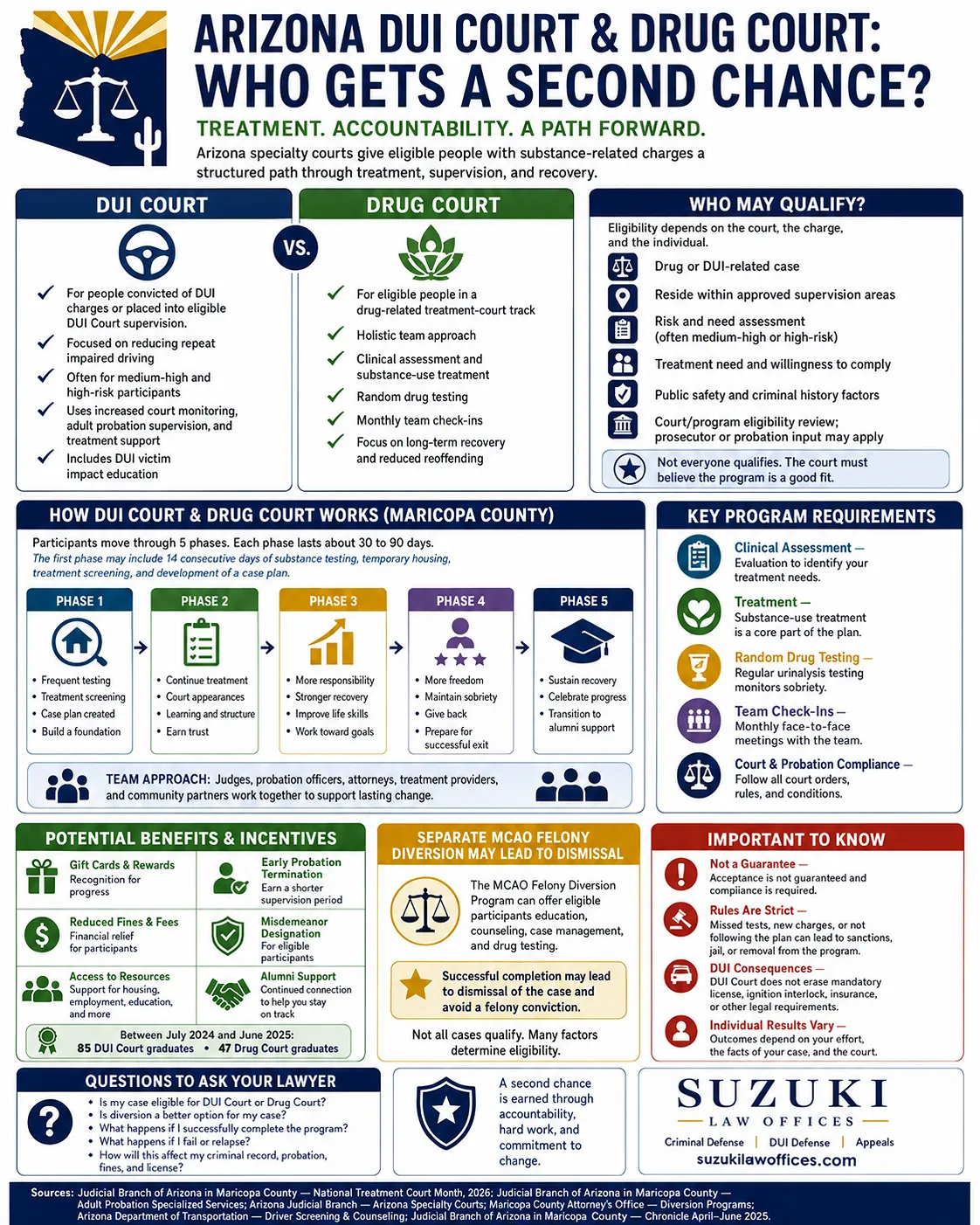
Maricopa County reported in 2026 that Drug Court and DUI Court participants progress through five phases, each of which generally lasts between 30 and 90 days. The amount of time a person spends in the program can vary based on their progress, compliance, treatment needs, and response to any setbacks.
During the first phase, participants may need to complete 14 consecutive days of substance testing, obtain temporary or transitional housing when needed, undergo treatment screening, and develop an individual case plan. Later phases continue to build on that foundation as the participant works toward greater stability and completion of the program.
Along the way, a participant may have to manage:
- Court appearances
- Probation meetings
- Drug or alcohol testing
- Treatment sessions
- Housing needs
- Employment or school
- Family responsibilities
- Transportation
- Sobriety support
- Financial obligations
- Program rules
Before entering treatment court, a person should understand how often they will need to appear, test, attend treatment, and meet with probation. The program lasts for months and must be managed alongside everyday responsibilities, making the time commitment an important part of the decision.

What Are the Possible Benefits?
Treatment courts recognize progress as participants move through the program. In Maricopa County, those incentives can range from modest rewards for meeting short-term goals to changes that may reduce the length or financial burden of probation.
| Possible Incentive | Why It Matters |
| Gift cards | Recognition for progress |
| Early probation termination | Less time under supervision |
| Reduced fines and fees | Less financial pressure |
| Misdemeanor designation for eligible participants | Lower long-term consequences |
| Access to resources | More support for housing, treatment, and stability |
| Alumni support | Continued connection after graduation |
The benefits available to a particular participant depend on the offense, sentence, probation terms, and eligibility for the incentive being considered. A gift card or recognition may mark progress during the program, while early termination of probation, reduced financial obligations, or misdemeanor designation can have a more lasting effect.
Between July 2024 and June 2025, Maricopa County reported that 85 people graduated from DUI Court and 47 graduated from Drug Court.
Those graduates completed a program requiring continued treatment, testing, supervision, and court involvement, making graduation a significant milestone for both the participant and the treatment-court team.

Can Drug Court or DUI Court Get a Case Dismissed?
Participation in Drug Court or DUI Court does not automatically lead to dismissal. In Maricopa County, these programs generally operate through probation after a conviction or plea, while dismissal may be available through a separate diversion program.
The Maricopa County Attorney’s Office offers a Felony Diversion Program for certain eligible offenses, including some cases involving possession of controlled substances. Participants must meet the program’s eligibility requirements and generally have a minimal criminal history.
After completing an assessment, a participant may be assigned counseling, case management, drug testing, or other requirements based on their individual needs. Successful completion can result in the filed charges being dismissed, allowing the person to avoid a felony conviction in that case.
Drug Court and DUI Court may provide other benefits, including incentives, reduced financial obligations, early termination of probation, or misdemeanor designation for eligible participants.
Those outcomes depend on the charge, sentence, plea agreement, and court orders. Arizona DUI convictions also carry mandatory consequences that participation in DUI Court does not necessarily eliminate.
Before entering treatment court or diversion, a person should understand exactly what successful completion will accomplish. Important questions include:
- Will the charge be dismissed after completion?
- Could the charge be reduced?
- Is the offense eligible for misdemeanor designation?
- Could probation end early?
- Will any jail requirement change?
- Can fines or fees be reduced?
- What happens after a missed test or appointment?
- How does the program respond to relapse?
- What happens if the person is removed?
The answers should be found in the actual agreement, sentencing documents, probation terms, or program rules. A person should not assume that completing treatment will erase the conviction unless the written terms specifically provide for that outcome.
DUI Court Is Not the Same as Arizona DUI Screening
A DUI case may involve substance-use screening, education, or treatment even when the person is not participating in DUI Court. These requirements may come from the court or the Arizona Department of Transportation and can affect the restoration of driving privileges.
An MVD-ordered screening involves a face-to-face interview conducted by a licensed behavioral health professional or behavioral health technician. It must also include at least one standardized test for alcohol dependency or substance abuse. ADOT does not accept laboratory results by themselves as a substitute for the required screening.
The screening may result in a recommendation for education or treatment. An education program consists of at least 16 hours, while treatment includes 16 hours of education and at least 20 hours of group counseling. The provider reports completion to MVD when the requirement is connected to a person’s driving privileges.
These obligations remain separate from DUI Court. Someone may be ordered to complete DUI screening without ever entering the treatment-court program.
A DUI Court participant may also have separate responsibilities involving MVD, an ignition interlock device, license reinstatement, probation, and insurance requirements. Completing one part of the case does not necessarily satisfy the others, so each requirement must be tracked independently.
Drug Court Is Not the Same as Felony Diversion
Drug Court and felony diversion may both include substance-use treatment, but they take place at different stages of a criminal case and do not offer the same legal outcome.
Maricopa County’s Felony Diversion Program is an alternative to traditional case processing for people charged with certain eligible felony offenses. The program includes some controlled-substance possession cases and generally requires a minimal criminal history.
Services are determined through an assessment and may include cognitive-behavioral group counseling, individual counseling, case management, and drug testing. When a participant successfully completes the program, the filed charges can be dismissed so the person avoids a felony conviction in that case.
Drug Court generally operates through probation and continued judicial supervision. It provides clinical assessment, substance-use treatment, random testing, and regular review by the Drug Court team, but participation does not carry the same automatic opportunity to earn dismissal.
Diversion may be preferable when a person qualifies, and successful completion will avoid a conviction. Drug Court may be considered when diversion is unavailable, the case has already reached the probation stage, or the person would benefit from the program’s greater level of supervision. Choosing between them requires a close look at both the legal outcome and the obligations the person must complete.
Who May Not Be a Good Fit?
Eligibility does not necessarily mean that treatment court is the best resolution. Before agreeing to participate, a person should consider whether the program is available for the charge, whether its requirements are manageable, and how its potential outcome compares with the other options in the case.
Treatment court may not be the right fit when:
- The charge is not accepted by the program.
- The person lives outside the designated supervision area.
- The testing and attendance schedule cannot realistically be maintained.
- The person is unwilling to participate in substance-use treatment.
- The case involves concerns that prevent acceptance into the program.
- Another resolution would provide a better legal outcome.
- The evidence supports a defense that should be investigated before entering a plea.
- The consequences of removal would create too much risk.
- Transportation, employment, health, or family responsibilities make compliance impractical.
The demands of treatment court should not automatically discourage someone who could benefit from the program. At the same time, the promise of treatment should not cause a person to overlook a viable defense or accept terms they cannot reasonably complete.
The decision should account for the entire case: the strength of the evidence, the available defenses, the likely outcome of traditional prosecution, the requirements of the program, and what happens after either successful completion or removal.
What Happens If Someone Fails Treatment Court?
A missed appointment or positive test does not necessarily result in immediate removal. Treatment courts recognize that recovery may include setbacks, and the team can respond with additional testing, treatment, supervision, or other court-approved measures based on the circumstances.
Possible responses to noncompliance may include:
- More frequent substance testing
- Additional treatment requirements
- Court-imposed sanctions
- Loss of earned incentives
- More frequent court appearances
- Additional probation conditions
- Jail time when legally authorized
- Removal from the treatment-court program
- Other consequences under the person’s probation terms
The response may depend on what happened, whether the participant reported the problem honestly, and whether the conduct reflects a setback or an ongoing refusal to participate. Repeated violations, absconding, new criminal charges, dishonesty, or failure to remain engaged can place continued participation in jeopardy.
The consequences of failing diversion are different. Because diversion occurs as an alternative to ordinary prosecution, unsuccessful participation may return the case to the traditional criminal process and eliminate the opportunity to earn dismissal. The person could then face prosecution on the filed charges under the terms of the diversion agreement.
Before entering either program, a participant should know what conduct counts as a violation, how the program responds to relapse, and what legal position the person will be in if completion becomes impossible.
Why a Defense Lawyer Matters Before Treatment Court
Treatment courts are intended to address substance use and reduce repeat offenses, but they still operate within the criminal justice system. Entering one may require a plea, acceptance of probation conditions, or other decisions that affect the person long after treatment begins.
A defense lawyer can review questions such as:
- Does the charge qualify for the program?
- Is felony diversion available instead?
- How strong is the prosecution’s evidence?
- Is there a basis to challenge the stop, search, arrest, or chemical testing?
- What rights would be given up under the plea agreement?
- What happens if the person cannot complete the program?
- Could an eligible felony eventually be designated a misdemeanor?
- Is early termination of probation possible?
- Which fines, fees, and treatment costs will remain?
- Are the testing and attendance requirements manageable?
- Have the driver’s license consequences been addressed?
- Could the outcome affect immigration status or a professional license?
These questions should be answered before the person commits to a program, not after a violation or unexpected consequence occurs. The goal is to determine whether treatment court provides a better overall resolution than the other paths available in the case.
A Second Chance Still Requires Significant Work
Calling Drug Court or DUI Court an alternative to traditional punishment can make the programs sound easier than they are. In practice, participants may spend months attending treatment, submitting to substance testing, meeting with probation, appearing in court, and working through a series of program phases.
That level of oversight can be difficult to manage alongside employment, school, transportation, housing, and family responsibilities. Progress may not follow a straight line, and completing every requirement demands consistency over an extended period.
For someone prepared to participate, however, the structure can provide more than another set of probation conditions. Treatment court may help a participant develop stronger recovery support, establish stability, address problems connected to substance use, and reduce the likelihood of returning to the criminal justice system.
Some participants may also qualify for incentives that reduce the duration or financial burden of probation.
Those results are earned through continued participation rather than promised at admission. The value of treatment court lies in the combination of accountability and support it provides to people who are ready and able to complete the work.
Speak With a Phoenix DUI Lawyer About Treatment-Court Options
Drug Court and DUI Court can provide a structured treatment path for eligible participants in Maricopa County. Although the programs share certain features, they differ from felony diversion, standard probation, and the screening or education requirements imposed in an Arizona DUI case.
The right option depends on more than the name of the charge. Eligibility, supervision area, assessed risk level, available defenses, probation status, and the terms of any plea or diversion agreement may all affect the decision. The possible outcome matters as well: diversion may allow an eligible person to earn dismissal, while treatment court may offer incentives or probation benefits without eliminating the underlying conviction.
Before accepting any program, a person should know what they will be required to complete, what benefit they may receive, and what happens if they cannot finish. Those details can affect the criminal case, probation, driving privileges, employment, and other parts of the person’s future.
Suzuki Law Offices represents people facing DUI charges, drug offenses, probation matters, and other criminal cases in Phoenix, throughout Maricopa County, and across Arizona.
A Phoenix DUI lawyer from the firm can review the available treatment-court and diversion options, examine the evidence, and explain how each possible resolution could affect the case.
Call or text (602) 682-5270 or complete a Free Case Evaluation form