

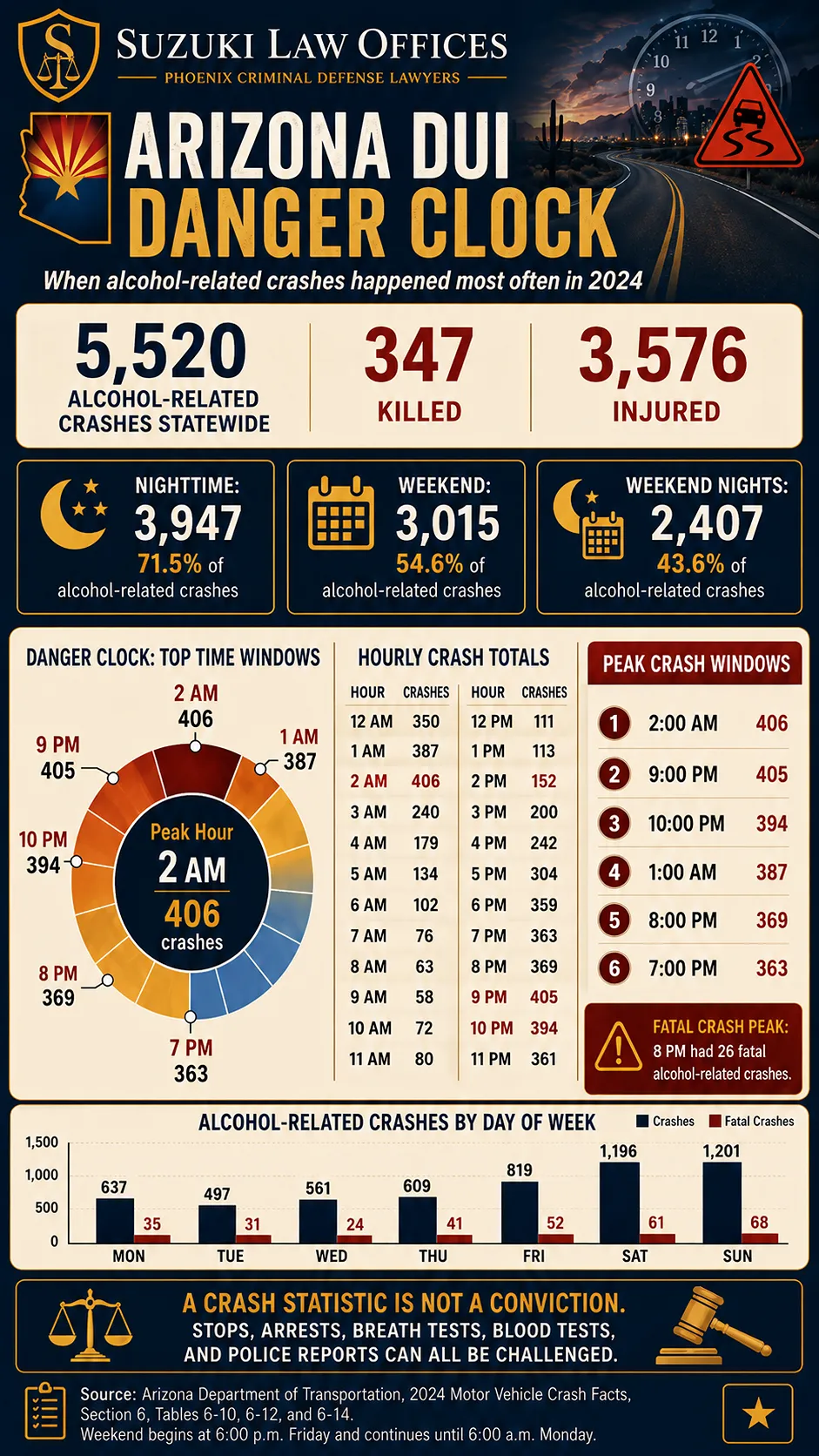
The most dangerous hour for alcohol-related crashes in Arizona in 2024 was not midnight. It was not right after last call. It was not the end of rush hour. According to the Arizona Department of Transportation’s 2024 Motor Vehicle Crash Facts report, the peak hour for alcohol-related crashes statewide in 2024 was 2:00 a.m, with 406 crashes reported during that hour. The crashes at this time heavily leaned towards weekend occurrences.
The second-highest hour was 9:00 p.m., with 405 alcohol-related crashes. The third-highest was 10:00 p.m., with 394 crashes. Crashes at these times occurred throughout the week.
Those numbers tell a story Arizona drivers, families, and anyone facing a DUI allegation should understand: alcohol-related crash risk does not belong to one hour, one holiday, or one part of town.
If you have been charged in an alcohol-related crash, a DUI defense lawyer in Phoenix from Suzuki Law Offices can help.
Alcohol-Related Crashes in Arizona
In 2024, Arizona reported:
| 2024 Arizona Alcohol-Related Crash Data | Total |
| Alcohol-related crashes statewide | 5,520 |
| People killed in alcohol-related crashes | 347 |
| People injured in alcohol-related crashes | 3,576 |
| Alcohol-related crashes at night | 3,947 |
| Alcohol-related crashes on weekends | 3,015 |
| Alcohol-related crashes on weekend nights | 2,407 |
Those numbers matter for public safety. They also matter for criminal defense.
The Arizona DUI Danger Clock
ADOT’s hourly crash data shows the clearest pattern: alcohol-related crashes in Arizona rise sharply during the evening and remain high through the early morning.
The six highest crash windows in 2024 were:
| Rank | Hour Beginning | Alcohol-Related Crashes |
| 1 | 2:00 a.m. | 406 |
| 2 | 9:00 p.m. | 405 |
| 3 | 10:00 p.m. | 394 |
| 4 | 1:00 a.m. | 387 |
| 5 | 8:00 p.m. | 369 |
| 6 | 7:00 p.m. | 363 |
This pattern is useful because it shows that Arizona’s alcohol-related crash risk is not limited to the stereotypical “bar closing” moment. The danger window starts much earlier.
By 6:00 p.m., alcohol-related crashes had already climbed to 359 for the year. By 7:00 p.m., the count rose to 363. At 8:00 p.m., Arizona saw 369 alcohol-related crashes, and that hour also had the highest fatal crash count, with 26 fatal alcohol-related crashes.
Then the late-night hours took over. At 9:00 p.m., alcohol-related crashes jumped to 405. At 10:00 p.m., there were 394. At 1:00 a.m., there were 387. At 2:00 a.m., the clock hit its peak at 406.
The takeaway is simple: Arizona’s DUI danger clock starts ticking before many people think they are in the “risky” part of the night.
Nighttime Crashes Made Up Most Alcohol-Related Crashes
ADOT defines daytime as 6:00 a.m. to 6:00 p.m. Nighttime covers the hours outside that window.
In 2024, Arizona had 3,947 nighttime alcohol-related crashes out of 5,520 total alcohol-related crashes. That means 71.5% of alcohol-related crashes happened at night.
That number is important because nighttime driving can add multiple risk factors at once:
- Poorer visibility.
- Fatigue.
- Weekend traffic.
- Social drinking.
- Bar and restaurant closings.
- Rideshare shortages.
- Long drives across spread-out metro areas.
- Drivers leaving events, house parties, casinos, clubs, concerts, and sporting events.
In a DUI case, the hour of the stop or crash may shape how police describe the investigation. Late-night driving can lead officers to expect impairment before they have strong evidence. That expectation can color how police interpret driving behavior, speech, balance, eye movement, odor, and statements at the scene.
That does not mean an arrest was lawful. It does not mean impairment can be proven. It means the defense may need to look closely at what the officer actually observed, what the video shows, and what evidence supports the state’s version of events.

Weekends Carried More Than Half of Alcohol-Related Crashes
ADOT’s report defines the weekend as beginning at 6:00 p.m. Friday and continuing until 6:00 a.m. Monday.
Using that definition, Arizona had 3,015 weekend alcohol-related crashes in 2024. That was 54.62% of all alcohol-related crashes statewide.
The day-of-week data makes the weekend pattern even clearer:
| Day | Alcohol-Related Crashes | Fatal Alcohol-Related Crashes |
| Monday | 637 | 35 |
| Tuesday | 497 | 31 |
| Wednesday | 561 | 24 |
| Thursday | 609 | 41 |
| Friday | 819 | 52 |
| Saturday | 1,196 | 61 |
| Sunday | 1,201 | 68 |
Saturday and Sunday were the highest crash days by far. Sunday had the most alcohol-related crashes overall, with 1,201, and the most fatal alcohol-related crashes, with 68.
That may surprise people who assume Friday night is the main danger point. Friday did show a sharp increase, with 819 alcohol-related crashes, but Saturday and Sunday were far higher.
There may be practical reasons for that. Weekend driving often includes late-night trips, overnight travel, social events, and early-morning returns from the prior night. Under ADOT’s definition, the weekend includes Sunday morning through 6:00 a.m. Monday, which captures many late-night and early-morning incidents.

Weekend Nights Were the Core Risk Zone
ADOT reported 2,407 alcohol-related crashes on weekend nights in 2024. That was 43.6% of all alcohol-related crashes statewide.
Which means that less than half of the week’s hours carried nearly half of the alcohol-related crash total. That is the kind of stat that makes a strong public safety message. It is also the kind of stat that can explain why law enforcement tends to increase DUI patrols during weekends, holidays, and nighttime windows.
However, increased enforcement can create its own legal issues. More patrols can mean more traffic stops. More stops can mean more borderline cases where DUI arrests deserve a close review.
A DUI arrest is not just about the number on a test. A defense may involve evidence like:
- The reason for the stop.
- The officer’s observations.
- Body camera footage.
- Dash camera footage.
- Field sobriety testing.
- Implied consent warnings.
- Blood draw procedures.
- Lab handling.
- Medical issues.
- Rising blood alcohol arguments.

Why the 2:00 a.m. Peak Matters
By 2:00 a.m., many drivers on the road may be leaving a bar or an event. Others may be working late shifts or driving home from family obligations.
Police may view 2:00 a.m. driving through a DUI lens, even before a case begins. A minor traffic issue at 2:00 p.m. may be treated like a normal traffic stop. The same issue at 2:00 a.m. may turn into questions about drinking, field sobriety tests, and a DUI investigation.
That does not make the stop valid by itself. Officers still need a lawful basis for the stop. The defense still has the right to challenge how the investigation began and how the evidence was collected.
Why Evening Hours Deserve More Attention
The 2024 data shows a strong late-night peak, but the evening shows that crashes happen throughout the later portion of the day.
At 5:00 p.m., Arizona reported 304 alcohol-related crashes. At 6:00 p.m., the number rose to 359. At 7:00 p.m., it was 363. At 8:00 p.m., it reached 369, with the highest fatal crash count of any hour.
That means the danger window is not only after midnight. For drivers, that is a reminder to plan a ride before drinking begins.
For people facing DUI allegations, it is a reminder that Arizona law enforcement may treat evening driving patterns as seriously as those late at night. At Suzuki Law Offices, we help people understand their rights and challenge DUI charges based on the specific facts of their cases—not assumptions tied to the time of day.
Arizona DUI Charges Can Escalate Quickly
Arizona DUI law can be harsh, and the charge level can change based on the facts alleged. Types of DUI charges include:
Standard DUI
A standard DUI may involve allegations that a person was impaired to the slightest degree, had a blood alcohol concentration of 0.08 or more within two hours of driving or being in actual physical control, or had certain drugs or metabolites in the body.
Extreme DUI
An extreme DUI generally involves an alleged alcohol concentration of 0.15 or more. A super extreme DUI involves a higher alleged alcohol concentration.
Aggravated DUI
Aggravated DUI can involve felony allegations tied to circumstances such as:
- A suspended or revoked license.
- A required ignition interlock device.
- Prior DUI history.
- Having a passenger under age 15.
What Different DUI Charges Mean
Having different charges means two cases that look similar from the outside may carry very different risks.
A person stopped at 9:00 p.m. after dinner may face one type of allegation. A person arrested after a crash at 2:00 a.m. with a high blood alcohol result may face a very different situation. A person with prior DUI history, a suspended license, or a child in the car may face felony exposure.
The facts matter. The timeline matters. The testing method matters. The defense strategy matters.
Alcohol-Related Crash Data Does Not Prove Impairment in an Individual Case
Statewide crash statistics are useful for spotting patterns, but they do not prove what happened in any one case.
An alcohol-related crash statistic does not answer the questions that matter in court:
- Was the traffic stop lawful?
- Was the driver actually impaired?
- Was the person in actual physical control of the vehicle?
- Was the breath test properly administered?
- Was the blood draw done correctly?
- Was the sample stored and tested properly?
- Did the officer follow policy?
- Did the report leave anything out?
- Does video match the written narrative?
- Did a medical condition, fatigue, injury, anxiety, or shock affect the investigation?
- Can the state prove every element beyond a reasonable doubt?
This is where DUI defense often begins. Suzuki Law Offices reviews every aspect of a DUI investigation, from the initial traffic stop to chemical testing procedures, to identify weaknesses in the prosecution’s case.
What to Do After a DUI Arrest in Arizona
After a DUI arrest, the biggest mistake is assuming the case is already decided. Arizona DUI cases can involve criminal court, license consequences, ignition interlock issues, insurance issues, employment concerns, immigration concerns, and probation conditions. A conviction can follow a person long after the traffic stop is over.
If you were arrested after a crash, the stakes may be even higher. Prosecutors may look at whether there were additional factors like:
- Injury.
- Property damage.
- Alleged alcohol concentration.
- Passenger status.
- Prior history.
Important First Steps
Protecting your legal rights can include:
- Saving any paperwork from the arrest
- Writing down what happened while your memory is fresh
- Preserving ride receipts, text messages, photos, videos, and location data
- Avoiding social media posts about the case
- Not contacting witnesses in a way that could create problems
- Speaking with a DUI defense lawyer as soon as possible
The earlier a defense team like Suzuki Law Offices can review the stop, footage, reports, testing, and timeline, the more opportunities there may be to challenge weak evidence.
The Patterns of Arizona’s DUI Danger Clock
Arizona’s 2024 DUI crash data shows a clear pattern. The highest-risk crash windows clustered at night and weekends carried more than half of alcohol-related crashes. While the single highest crash hour was 2:00 a.m., the hours between 8:00 p.m. and 10:00 p.m. were also major danger periods.
For anyone facing a DUI charge after a crash, remember that an arrest is not a conviction. Even when a case involves a crash, a late-night stop, or a chemical test, the evidence still has to be examined piece by piece.
Suzuki Law Offices defends people facing DUI and criminal charges in Phoenix, Scottsdale, Mesa, Tempe, Glendale, and throughout Arizona. If you have been arrested or charged with DUI, contact our Arizona DUI defense team to discuss your case.
Sources
- Arizona Department of Transportation, 2024 Motor Vehicle Crash Facts, Section 6, Tables 6-10, 6-12, 6-13, and 6-14.
- Arizona Revised Statutes § 28-1381, Driving or actual physical control while under the influence.
- Arizona Revised Statutes § 28-1382, Driving or actual physical control while under the extreme influence.
- Arizona Revised Statutes § 28-1383, Aggravated driving or actual physical control while under the influence.
Call or text (602) 682-5270 or complete a Free Case Evaluation form