

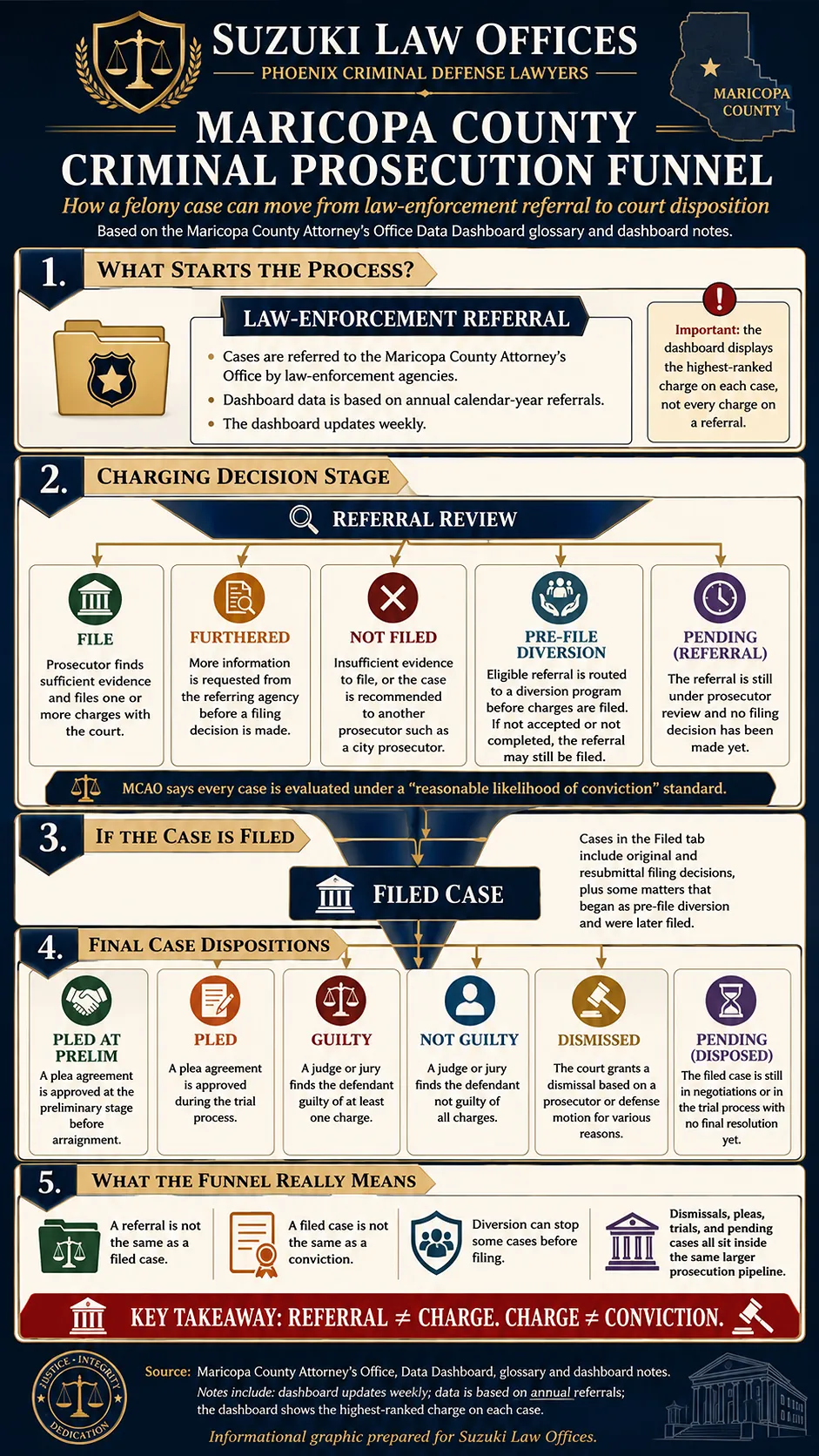
The Maricopa County criminal prosecution funnel shows the distance between an accusation and a final result. A police report is not a conviction. A referral does not mean charges will be filed, and a filed criminal case is not proof of guilt. That is the point of the Maricopa County criminal prosecution funnel.
When law enforcement believes a felony may have occurred, the case may be submitted to the Maricopa County Attorney’s Office for review. From there, the case can move in several directions. It may be filed with the court, sent back for more information, declined, or enter pre-file diversion.
It may stay pending while prosecutors review evidence. After charges are filed, the case is still not over. It can end through a plea, dismissal, trial, not guilty verdict, guilty verdict, or a pending status. If you need help understanding the process, reach out to our criminal defense lawyers in Maricopa.
What Starts the Maricopa County Criminal Prosecution Process?
The process often begins with a law-enforcement referral. A referral means a law-enforcement agency has submitted a case to the Maricopa County Attorney’s Office for prosecutor review. The referring agency may be Phoenix Police, Mesa Police, Scottsdale Police, Glendale Police, Chandler Police, Tempe Police, the Maricopa County Sheriff’s Office, DPS, or another agency.
At this stage, the prosecutor is reviewing what law enforcement submitted. That may include police reports, witness statements, body camera footage, photographs, lab reports, crash reports, search warrant materials, surveillance video, and other case evidence.
A referral is not the same as a filed criminal case. A person can be investigated. A police agency can submit a case. A prosecutor can review it. None of that automatically means felony charges will be filed.
The Dashboard Warning People Often Miss
The Maricopa County Attorney’s Office Data Dashboard includes an important note: dashboard data is based on annual calendar-year referrals and shows the highest-ranked charge on each case, not every charge on a referral.
That matters because one criminal investigation may include several possible charges. The dashboard does not show every allegation in every referral. It shows the highest-ranked charge on each case for reporting purposes.
That means a dashboard category can help explain broad prosecution patterns, but it cannot tell you everything about one person’s case.
Important Points for Defendants
For an individual defendant, the details matter more than the dashboard label:
- What did officers claim happened?
- What charge did prosecutors actually file?
- Were any charges declined?
- Were any charges reduced?
- Was diversion offered?
- Was the case dismissed?
- Did the state have enough evidence to prove the charge?
Those questions sit at the center of a real defense.
What Happens During Referral Review?
Once a case is referred, prosecutors decide what should happen next.
The Maricopa County Attorney’s Office Data Dashboard glossary lists several charging decision outcomes:
| Charging Decision | What It Means |
| File | A prosecutor finds sufficient evidence and files one or more charges with the court. |
| Furthered | The prosecutor asks the referring law-enforcement agency for more information before making a filing decision. |
| Not Filed | The prosecutor does not find sufficient evidence to file, or the case is recommended to another prosecutor, such as a city prosecutor. |
| Pre-File Diversion | An eligible referral is sent to a diversion program before charges are filed. If the person does not accept or complete the program, the referral may still be filed. |
| Pending Referral | The referral is still under prosecutor review, and no filing decision has been made yet. |
This stage can be confusing for people because a person may know police are investigating them, but no formal charges have appeared in court yet. That does not mean the case is harmless. It also does not mean charges are guaranteed. It means the case is sitting inside the review stage of the funnel.
This stage can be confusing for people because a person may know police are investigating them, but no formal charges have appeared in court yet. That does not mean the case is harmless. It also does not mean charges are guaranteed. It means the case is sitting inside the review stage of the funnel.

The “Reasonable Likelihood of Conviction” Standard
The Maricopa County Attorney’s Office has publicly described its charging standard as whether there is a “reasonable likelihood of conviction.” In plain English, that means prosecutors are supposed to evaluate whether the evidence is strong enough to support a criminal charge that can be proven in court.
Filing a felony case is a serious matter. A charge can affect a person’s job, family, license, immigration status, reputation, housing, education, and future opportunities. This standard reminds us that weak evidence shouldn’t lead to filing a case simply because there is a police report.
A defense lawyer can challenge the referral before it is filed. They can request a more thorough review, present defense evidence, highlight missing evidence, expose contradictions, or argue that the case doesn’t meet the standard for filing.

What Does “Furthered” Mean?
“Furthered” means the prosecutor is not ready to file the case yet and is asking the referring agency for more information. This can happen when the prosecutor needs missing reports, lab results, video, witness follow-up, corrected paperwork, more investigation, or clarification about what happened.
A furthered referral is not a dismissal or a conviction, and it is not the same as filed charges. It means the case is still active, but prosecutors need more before making a filing decision.
Depending on the circumstances and the status of the referral, a defense lawyer may be able to provide relevant information, identify missing evidence or contradictions, or argue that the matter does not meet MCAO’s charging standard.

What Does “Not Filed” Mean?
“Not filed” means the prosecutor does not file the case in Maricopa County Superior Court based on the referral. The dashboard glossary explains that this can mean the prosecutor did not find sufficient evidence to file or the case was recommended to another prosecutor, such as a city prosecutor.
Sometimes “not filed” means the case is effectively declined at the felony level. But a “not filed” decision at MCAO does not necessarily mean that no prosecution is possible. A matter may be sent to a city prosecutor for possible misdemeanor prosecution.
In some cases, a person may still need to watch for future filings, refiling, or a separate municipal court case. A not-filed decision is often good news, but it should be reviewed carefully so the person understands whether the case is truly over.

What is Pre-File Diversion?
Pre-file diversion programs may allow an eligible person to complete a program before criminal charges are filed. According to MCAO, successful completion means the referral is not filed. If the person does not accept or complete the program, the referral may still be filed.
That makes pre-file diversion powerful. It can allow a person to avoid a filed felony case, but it can also carry requirements, deadlines, program conditions, fees, treatment, classes, restitution, or other obligations.
Eligibility depends on the requirements of the particular diversion program and MCAO policy. Before agreeing to diversion, a person should understand what they are committing to, what will happen after they complete the program, and what will occur if they are unable to finish it.
What Happens If the Case is Filed?
If prosecutors file charges, the referral becomes a filed case. The MCAO dashboard notes that the Filed tab includes the original filing decisions, resubmittal filing decisions, and some matters that began as pre-file diversion but were later filed.
Once charges are filed, the case proceeds through the applicable court process. Depending on how the case began and whether probable cause is determined at a preliminary hearing or grand jury proceeding, the process may include an initial appearance, release conditions, arraignment, disclosure, plea negotiations, motions, conferences, and trial.
A filed case raises the stakes. The person is now formally accused in court. However, a filed case is not the same as a conviction. The defense can still challenge evidence, negotiate, file motions, seek dismissal, prepare for trial, and fight for a better result.
Filed Case Status or Disposition
The MCAO dashboard glossary lists several filed case dispositions.
| Final Case Disposition | What It Means |
| Pled at Prelim | A plea agreement is approved at the preliminary stage before arraignment. |
| Pled | A plea agreement is approved during the trial process. |
| Guilty | A judge or jury finds the defendant guilty of at least one charge. |
| Not Guilty | A judge or jury finds the defendant not guilty of all charges. |
| Dismissed | The court grants a dismissal based on a prosecutor or defense motion for various reasons. |
| Pending Disposed | The filed case is still in negotiations or in the trial process with no final resolution yet. |
These outcomes are very different. A plea is not the same as a trial loss. A dismissal is not the same as a not guilty verdict. A pending case is not a conviction. A guilty verdict on one charge does not always mean guilt on every charge originally alleged.
This is why the funnel is important. It keeps the stages separate.
Why Dismissals Matter in the Prosecution Funnel
A dismissal means the court grants a dismissal based on a prosecutor or defense motion for various reasons.
Sometimes, evidence might be missing, or a witness may not be available. The state could find a problem with the evidence. A defense motion might succeed, or a constitutional issue could weaken the case. A plea deal in another case may resolve the issue.
New facts can also change how the prosecution views the case. In some cases, dismissal may come early. In others, it may happen after months of litigation. The important point is this: filed charges do not always survive the funnel.
Why Pleas Matter in the Prosecution Funnel
Many criminal cases resolve by plea agreement. A plea may happen at the preliminary hearing stage, before arraignment, or later during the trial process. The terms can vary widely. A plea may involve:
- Charge Reduction.
- Sentencing Agreements.
- Probation Terms.
- Prison Exposure.
- Fines, Classes.
- Treatment.
- Restitution.
- Dismissal Of Other Counts.
A plea can be the right strategy in some cases. In others, the better approach may be to continue fighting, file motions, demand additional disclosure, seek expert review, or prepare for trial. The right choice depends on the evidence, the risk, the client’s goals, the offer, the judge, the charge, and the potential sentence.
Why “Pending” Does Not Mean Nothing is Happening
The Maricopa County criminal prosecution funnel has two pending categories. Both can feel like limbo.
- “Pending referral” means the case is still under prosecutor review and no filing decision has been made.
- “Pending disposed” means a filed case is still in negotiations or in the trial process with no final resolution yet.
A person may be waiting on lab results, discovery, witness interviews, defense investigation, plea negotiations, court dates, motions, or a trial setting.
Waiting can be tough, but it can also strengthen your defense. This time may expose weaknesses in the state’s case. It gives the defense a chance to gather records, locate witnesses, review videos, challenge lab work, or seek dismissal or reduction.
What the Funnel Really Means for Defendants
The Maricopa County criminal prosecution funnel has one main lesson: The process has stages, and each stage matters.
A referral is not the same as a filed case. A filed case is not the same as a conviction. Diversion can stop some cases before filing. Dismissals, pleas, trials, and pending cases all sit inside the larger prosecution pipeline. For someone accused of a crime, this means there may be more room to fight than they think.
The defense may begin before charges are filed. It may continue through referral review, charging decisions, court filings, negotiations, motion practice, and trial. The earlier a defense lawyer can identify the stage of the funnel, the easier it may be to protect the client’s rights and target the right outcome.
Questions to Ask If Your Case Was Referred to MCAO
If police said they are sending your case to the Maricopa County Attorney’s Office, ask these questions:
- Has the case actually been submitted to MCAO?
- Has a prosecutor made a filing decision?
- Is the case pending, furthered, not filed, or filed?
- Is pre-file diversion possible?
- Was the case sent to a city prosecutor?
- Are there missing lab results or reports?
- Does video evidence support the police narrative?
- Are witnesses reliable?
- Did police make a lawful stop, search, seizure, or arrest?
- Is there enough evidence for a reasonable likelihood of conviction?
These questions can shape the defense strategy before the case hardens into a filed felony prosecution.
The Bottom Line for the Maricopa County Criminal Prosecution Funnel
The Maricopa County prosecution funnel is a powerful reminder that the criminal process is not one step. It is a sequence. Referral does not equal charge. Charge does not equal conviction.
Law enforcement can send a case for review. Prosecutors can review it, and they can choose to file it, advance it, decline it, divert it, or leave it pending. If they file it, the case can end in several ways: through a plea deal, dismissal, trial, a not guilty verdict, a guilty verdict, or ongoing litigation. At every step, evidence is important.
Since 2007, Suzuki Law Offices has been defending people facing felony and misdemeanor charges in Phoenix, Scottsdale, Mesa, Tempe, Glendale, Chandler, and throughout Maricopa County. If your case has been referred, filed, or is under review, contact our criminal defense team to discuss the next move.
Additional Resources and Further Reading
- MCAO: No Likelihood of Conviction in Chandler Drowning Case
- MCAO Charging Decision Remarks
- Arizona Judicial Branch: Steps in a Criminal Case
- Arizona Judicial Branch: How a Case Moves Through the Court System
- MCAO FY 2025 Annual Activity Report
Call or text (602) 682-5270 or complete a Free Case Evaluation form