

What Is Horizontal Gaze Nystagmus (HGN)?
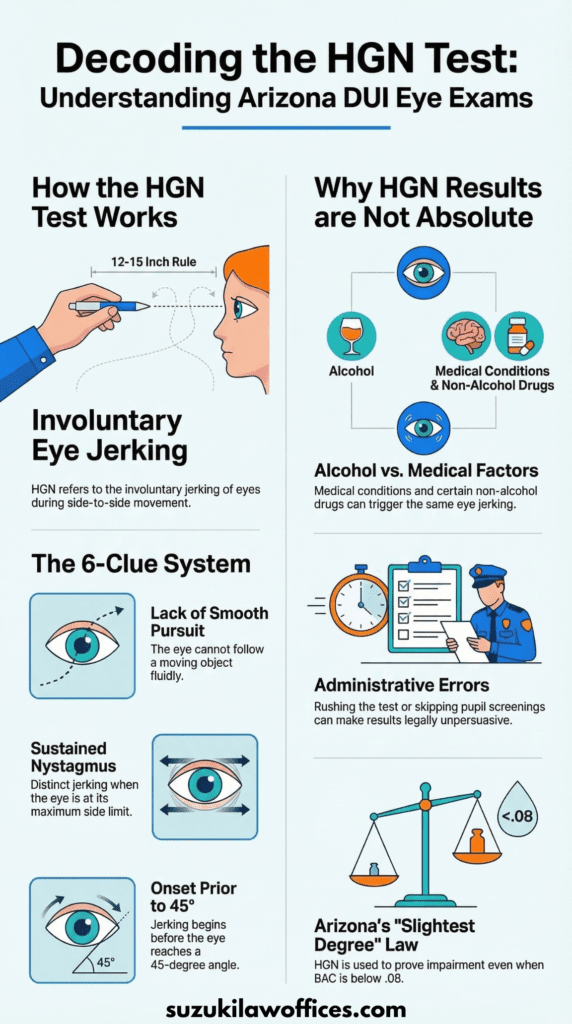
HGN stands for horizontal gaze nystagmus. It refers to an involuntary jerking of the eyes as they move side to side. During a DUI stop, an officer may ask a driver to follow a pen, finger, or small light with their eyes while the officer watches for signs of HGN. NHTSA treats HGN as one of the three standardized field sobriety tests used in impaired-driving investigations.
For many drivers, the first question is simple: Does HGN mean I am guilty of DUI? Not by itself. HGN is one part of a roadside investigation, and Arizona DUI cases can involve many pieces of evidence, including officer observations, driving behavior, statements, and chemical testing. Arizona law also allows DUI charges when a person is under the influence and impaired to the slightest degree, even apart from a .08 BAC theory.
Suzuki Law Offices represents people facing DUI allegations across Arizona. The firm highlights its background as former prosecutors, which can matter when the defense needs to examine how an officer administered a test, what the report says, and whether the State is overstating what HGN really shows.
How Does the HGN Test Work?
The officer usually positions a stimulus about 12 to 15 inches from the driver’s face and asks the driver to follow it with their eyes only. Before scoring the test, NHTSA training materials instruct officers to check for equal pupil size, resting nystagmus, and equal tracking. Those steps matter because eye movement can be affected by more than alcohol alone.
NHTSA materials describe three HGN clues in each eye: lack of smooth pursuit, distinct and sustained nystagmus at maximum deviation, and onset of nystagmus prior to 45 degrees. Because each clue is checked in both eyes, there can be up to six total clues.
What HGN Can Suggest and What It Cannot
HGN can be useful to police because alcohol can interfere with the brain’s ability to control eye movement. NHTSA materials also say HGN may appear with certain other drugs, and some medical conditions can affect nystagmus as well. That is one reason DUI defense often turns on details like training, instructions, timing, lighting, distractions, and the driver’s medical history.
That makes HGN important, though not untouchable. A roadside HGN test is still an observational test performed by a human officer under field conditions. Suzuki Law Offices can review whether the officer followed the proper steps and whether the State is trying to stretch the HGN result farther than the evidence supports.

The HGN Test at a Glance
| What HGN means | HGN means horizontal gaze nystagmus, or involuntary jerking of the eyes as they gaze to the side. |
| Where it fits in a DUI stop | HGN is one of the three standardized field sobriety tests in the NHTSA battery. |
| What officers look for | Officers are trained to look for three clues in each eye, for a possible total of six clues. |
| What can affect the test | NHTSA materials note that alcohol, certain drugs, and some medical conditions can affect nystagmus. |
| Why the HGN test matters in Arizona | Arizona DUI law includes driving while impaired to the slightest degree, so officers may use HGN as part of the impairment case. |
| Why legal review matters | Suzuki Law Offices says its former prosecutor experience helps it analyze how evidence was gathered and where the State’s case may be vulnerable. |

Are HGN Tests Reliable?
HGN is widely used in DUI investigations, and NHTSA training materials describe it as a key part of the standardized field sobriety test battery. Still, reliability depends on proper administration. If the officer rushes the test, skips screening steps, uses poor positioning, or ignores medical issues, the result may become much less persuasive.
That is where case review becomes valuable. Suzuki Law Offices can compare the police report, body camera footage, and test conditions against the way HGN is supposed to be given. An Arizona DUI case may look very different once the details are pulled apart.

HGN Test FAQs
Is HGN the same as a breath test?
No. HGN is a field sobriety test, not a chemical test. It is used during roadside investigation as one piece of the officer’s impairment assessment.
Can medical issues affect HGN?
Yes. NHTSA materials state that nystagmus may be linked to alcohol, certain drugs, and some medical conditions, which is why officers are trained to check for issues such as equal pupil size, resting nystagmus, and equal tracking before scoring clues.
Can you still fight a DUI if the officer says you showed HGN clues?
Yes. An HGN result does not end the case. A defense lawyer can examine training, instructions, environmental conditions, body cam footage, and whether the officer followed the testing method correctly. Suzuki Law Offices emphasizes preparation and strategic review, drawing on its attorneys’ experience within the criminal justice system.
Why call Suzuki Law Offices after an HGN-based DUI arrest?
Suzuki Law Offices lawyers’ former prosecutor background helps the firm evaluate how the State builds DUI cases and where the evidence may be weak. In a case that leans on roadside testing, that kind of close review can matter early.

Talk to Suzuki Law Offices About an HGN DUI Case
If an officer used HGN during your DUI stop, it is smart to have the test and the rest of the investigation reviewed as early as possible. Suzuki Law Offices tells prospective clients that early guidance can help them understand the charges, the evidence, and the next steps, providing a clearer picture of what is really at stake.
Call or text (602) 682-5270 or complete a Free Case Evaluation form