


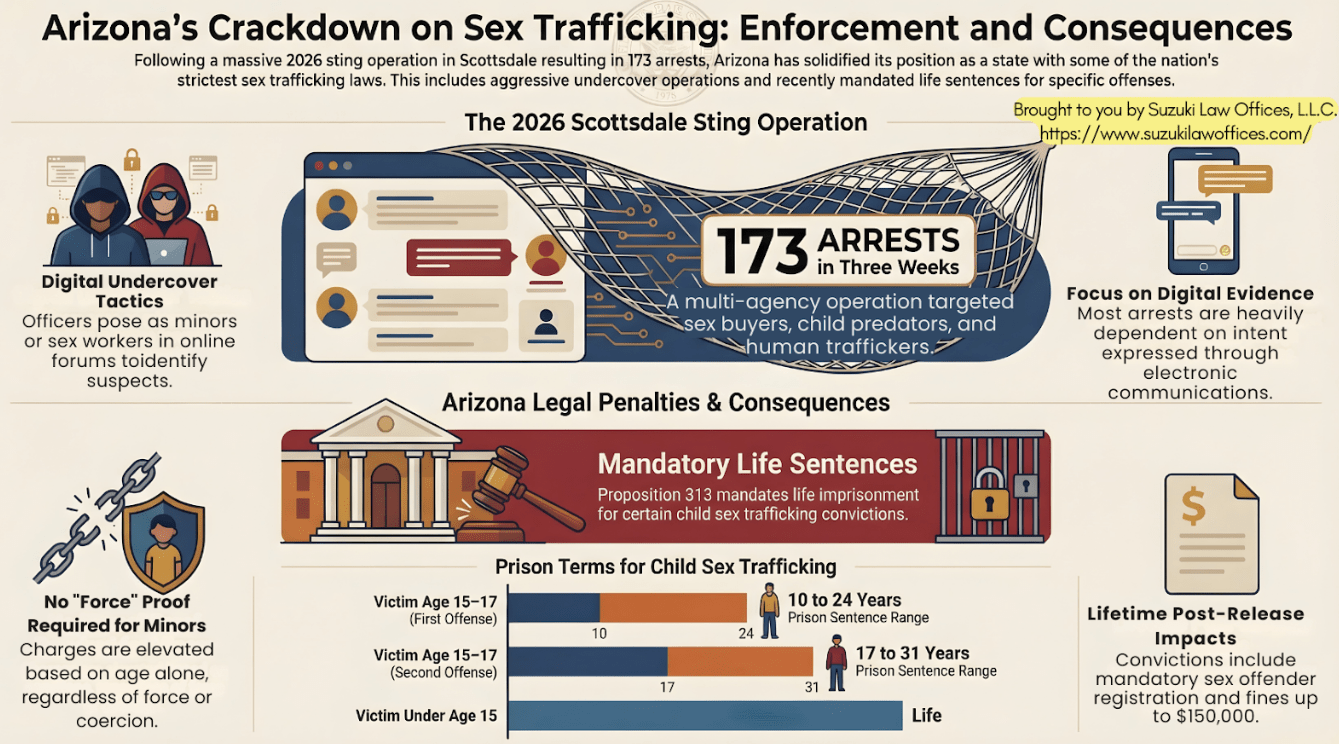
In early 2026, the Scottsdale Police Department’s Human Exploitation and Trafficking (HEAT) Unit led a multi-agency operation that resulted in 173 arrests over a three-week period between January 21 and February 14. The operation targeted alleged sex buyers, child predators, and individuals involved in prostitution and human trafficking activity.
Law enforcement officials stated that undercover officers posed as minors and adults in online forums. No actual children were involved in the sting. Authorities also reported that individuals identified as trafficking victims during the operation were offered services and recovery resources.
This operation reflects Arizona’s aggressive enforcement stance on sex trafficking and exploitation offenses. It also highlights the serious legal consequences individuals face when charged under Arizona’s trafficking and sex crime statutes.
This article explains:
- What happened in the Scottsdale operation
- How Arizona defines sex trafficking and related offenses
- The penalties involved
- Recent legislative changes
- Legal defenses that may apply in these cases
What Happened During the Scottsdale Operation
According to police, the Human Exploitation and Trafficking Unit coordinated with local and federal agencies to conduct undercover investigations focused on:
- Individuals attempting to engage in sexual conduct with minors
- Buyers soliciting prostitution
- People allegedly transporting or facilitating prostitution
- Suspects involved in broader trafficking activity
Over 173 individuals were arrested. Charges reportedly ranged from serious felonies such as:
- Child sex trafficking
- Attempted sexual conduct with a minor
- Luring a minor for sexual exploitation
To misdemeanor prostitution and solicitation offenses. Some arrests also involved unrelated allegations such as narcotics possession or weapons misconduct.
Operations like this are typically built around online communications. Officers pose as minors or sex workers. If a suspect expresses intent and arrives at a meeting location, an arrest is made.
These cases are often heavily dependent on digital evidence.
How Arizona Defines Human Trafficking
Under Arizona law, human trafficking occurs when a person knowingly recruits, transports, harbors, provides, obtains, or benefits from another person through force, fraud, or coercion for labor or commercial sex.
When the alleged victim is under 18, prosecutors do not need to prove force, fraud, or coercion. The minor’s age alone is enough to elevate the charge.
Arizona recognizes two primary categories:
1. Sex Trafficking
Involves commercial sexual exploitation.
2. Labor Trafficking
Involves forced labor or services obtained through coercion or deception.
Most high-profile sting operations focus on sex trafficking and child exploitation offenses.
Child Sex Trafficking in Arizona
Child sex trafficking is among the most serious charges under Arizona law.
A conviction can result in:
- 10 to 24 years in prison for a first offense involving a minor aged 15–17
- 17 to 31 years for a second offense
- 24 to 38 years for a third or subsequent offense
- A minimum of 13 years (and potentially life imprisonment) if the alleged victim is under 15
Additional consequences include:
- Mandatory prison (no probation eligibility in many cases)
- Lifetime sex offender registration
- Fines up to $150,000
- Asset forfeiture
- Restitution
In 2024, Arizona voters passed Proposition 313, which mandates life imprisonment for certain child sex trafficking convictions. This significantly increased sentencing exposure in these cases.
 Arizona Sex Trafficking and Exploitation Offenses |
||||||
|---|---|---|---|---|---|---|
| Offense Type | Legal Definition | Standard Penalty Range | Enhanced / Mandatory Penalties | Common Charges in Sting Operations | Legal Defenses | |
| Child Sex Trafficking (Victim under 15) |
Knowingly recruiting, transporting, harboring, providing, obtaining, or benefiting from a person under age 15 for commercial sex.
|
Minimum of 13 years.
|
Life imprisonment (mandated by Proposition 313 in certain cases); Mandatory prison; Lifetime sex offender registration.
|
Online child exploitation investigations; Decoy stings.
|
Lack of intent, entrapment, mistaken identity, digital forensic gaps.
|
|
| Child Sex Trafficking (Victim 15–17) |
Knowingly recruiting, transporting, harboring, providing, obtaining, or benefiting from a person under 18 for commercial sex (force/fraud/coercion not required for minors).
|
10 to 24 years (first offense); 17 to 31 years (second offense); 24 to 38 years (subsequent offense).
|
Mandatory prison (no probation eligibility); Fines up to $150,000; Asset forfeiture; Lifetime sex offender registration.
|
Undercover decoys posing as minors in online forums.
|
Lack of intent, entrapment, mistaken identity, constitutional violations.
|
|
| General Sex Trafficking (Adult) |
Knowingly recruiting, transporting, harboring, providing, obtaining, or benefiting from another person through force, fraud, or coercion for commercial sex.
|
Typically ranges from 5 – 20 years for a first offense. Offenders are not eligible for suspended sentences or early release. Longer sentences for those with prior felonies.
|
Mandatory prison; Lifetime sex offender registration; Restitution.
|
Transporting or facilitating prostitution; Proactive hotel stings.
|
Lack of intent, entrapment, duress/coercion (if defendant is a victim), constitutional violations.
|
|
| Luring a Minor for Sexual Exploitation |
Using online communication or other means to attract a minor for sexual activity.
|
Multi-year mandatory prison sentences.
|
Mandatory prison; Lifetime sex offender registration.
|
Undercover officers posing as minors in online forums.
|
Mistaken identity (device access/shared accounts), entrapment, lack of criminal intent.
|
|
| Possession of Child Pornography |
Illegal possession of visual depictions of minors engaged in sexual conduct.
|
10 to 24 years per count.
|
Mandatory prison; Lifetime sex offender registration.
|
Digital evidence seized during trafficking or luring investigations.
|
Constitutional violations (illegal searches/improper warrants), mistaken identity.
|
|
| Solicitation of Prostitution |
Seeking or hiring another for the purpose of sexual conduct.
|
Historically, a misdemeanor in Arizona.
|
Proposed legislation (HB 2720) seeks felony status and mandatory jail time.
|
Buyer enforcement operations; Online forum stings.
|
Entrapment, lack of intent, mistaken identity.
|
|

Other Charges Common in Sting Operations
In addition to trafficking charges, Scottsdale-style operations often result in allegations such as:
Attempted Sexual Conduct with a Minor
Can carry multi-year mandatory prison sentences.
Luring a Minor for Sexual Exploitation
Often charged in online communication cases involving undercover officers.
Transporting for Prostitution
Facilitating travel for the purpose of prostitution.
Solicitation of Prostitution
Historically a misdemeanor. However, legislative proposals such as House Bill 2720 aim to elevate solicitation to felony status and require mandatory jail time.
Possession of Child Pornography
Can carry 10 to 24 years per count.
The severity of potential sentencing means early legal intervention is critical.

The Role of the Scottsdale HEAT Unit
The Human Exploitation and Trafficking Unit is assigned to the Scottsdale Family Advocacy Center and focuses on:
- Domestic minor sex trafficking investigations
- Online child exploitation cases
- Buyer enforcement operations
- Proactive hotel and decoy stings
- Community education and partnerships
The unit works with federal task forces, including Internet Crimes Against Children (ICAC), and coordinates with victim advocacy services.

Statewide Anti-Trafficking Efforts
Arizona designates January as Human Trafficking Prevention Month. The Governor’s Office of Youth, Faith and Family coordinates statewide anti-trafficking efforts, including:
- Training for law enforcement and service providers
- Victim support funding
- Public awareness campaigns
- Human Trafficking Tip Line operations
According to state reporting, thousands of professionals have been trained to identify trafficking indicators. Arizona has invested millions into anti-trafficking enforcement and survivor services in recent fiscal years.
While enforcement continues to intensify, debate remains over how sting operations impact victims and whether buyer-focused crackdowns effectively reduce trafficking.
Legal Defenses in Trafficking and Sting Cases
An arrest does not equal a conviction. Prosecutors must prove every element of the charged offense beyond a reasonable doubt.
Common defense strategies may include:
Lack of Intent
The state must prove knowing participation. Misunderstandings, miscommunications, or lack of criminal intent can be critical.
Entrapment
If law enforcement induced someone to commit a crime they otherwise would not have committed, entrapment may be argued.
Mistaken Identity
Online cases require proof that the accused was actually the person communicating. Device access, shared accounts, and digital forensic gaps can create reasonable doubt.
Constitutional Violations
Illegal searches, improper warrants, or coerced statements can lead to suppression of evidence.
Duress or Coercion
In some cases, individuals charged in prostitution-related offenses may themselves be trafficking victims.
Each case depends on specific facts and evidence.
What to Do If You Are Under Investigation
If you believe you are under investigation or have been arrested:
- Do not speak to law enforcement without an attorney present.
- Do not consent to searches without a warrant.
- Preserve electronic devices and avoid deleting data.
- Avoid discussing the case with anyone except your attorney.
Digital evidence cases move quickly. Early defense strategy can significantly impact outcomes.
Why Experienced Representation Matters
Sex trafficking and exploitation charges carry life-altering consequences:
- Long mandatory prison sentences
- Lifetime sex offender registration
- Severe reputational damage
- Employment and housing barriers
Suzuki Law Offices is composed of former prosecutors who understand how these cases are built and prosecuted. That perspective allows us to identify weaknesses in investigations, challenge digital evidence, and aggressively defend clients facing serious allegations.
We defend individuals accused of:
- Sex trafficking
- Sexual conduct with a minor
- Child pornography
- Internet sex crimes
- Prostitution-related offenses
- Sexual assault
Every case requires a strategic, evidence-focused defense.
Final Thoughts
The 2026 Scottsdale human exploitation operation demonstrates Arizona’s continued focus on cracking down on sex trafficking and exploitation crimes. With 173 arrests in just three weeks, enforcement activity is unlikely to slow down.
At the same time, these cases are complex. They often rely on undercover tactics, digital communications, and aggressive charging decisions.
If you or a loved one is facing allegations related to a trafficking investigation, securing experienced criminal defense representation immediately is essential.
Suzuki Law Offices provides confidential case evaluations and aggressive defense for individuals charged with serious sex crimes throughout Arizona.
Contact us today to protect your rights.
Call or text (602) 682-5270 or complete a Free Case Evaluation form