

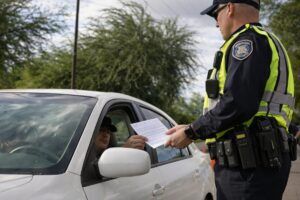
Every weekend in Phoenix, thousands of drivers encounter sobriety checkpoint operations across the Valley. Whether you are heading home from dinner in Scottsdale or driving through downtown Phoenix on a Friday night, understanding your constitutional rights during these encounters can make the difference between a brief stop and a life-changing arrest.
At Suzuki Law, we have defended thousands of DUI checkpoint cases throughout Arizona. Our background as former prosecutors gives us valuable insight into how Phoenix police conduct these operations, including the tactics they use, the procedures they are required to follow, and the constitutional protections many drivers do not realize they have.
The reality is that DUI checkpoints in Phoenix are often designed to feel intimidating. Officers are trained to look for signs of impairment, but they are also human and can make mistakes, overlook required procedures, or violate constitutional rights. Knowing what you are and are not required to do at these stops helps you protect yourself and your legal rights.
Understanding DUI Checkpoint Legality in Phoenix
DUI checkpoints in Phoenix are legal under both Arizona law and federal constitutional standards, but only when they are conducted correctly. The United States Supreme Court has ruled that these stops qualify as a limited exception to the Fourth Amendment’s protection against unreasonable searches and seizures.
That exception, however, comes with strict requirements. Phoenix police departments must follow specific protocols to ensure a checkpoint is legally valid. These requirements include advance public notice, neutral criteria for stopping vehicles, clear signage and lighting, and proper supervision throughout the operation.
Based on our experience defending checkpoint cases, we have seen many situations where Phoenix police fail to meet these legal standards. When checkpoints are not conducted according to established procedures, any evidence collected may be challenged, and charges can be dismissed.
The key takeaway is that while checkpoints are generally lawful, they must be executed precisely to withstand constitutional scrutiny. Our former prosecutor experience allows us to identify when law enforcement has cut corners or failed to follow required procedures.
Your Constitutional Rights at Phoenix DUI Checkpoints
Understanding your DUI checkpoint rights in Phoenix starts with knowing what police officers can and cannot legally require during these encounters. While sobriety checkpoints are permitted, the Constitution still provides important protections that remain fully in effect.
Your Right to Remain Silent
You have the right to remain silentbeyond providing basic identifying information. Phoenix police officers often ask questions intended to detect impairment, such as whether you have been drinking or where you are coming from.
You are not legally required to answer these questions. Politely declining to respond or stating that you are exercising your right to remain silent is lawful and cannot be used as evidence of guilt.
Your Right to Refuse Field Sobriety Tests
Field sobriety tests are voluntary in Arizona. Officers may request that you perform tasks such as walking a straight line, standing on one leg, or following an object with your eyes, but they cannot legally require you to do so.
These tests are subjective and often unreliable. Even sober drivers can perform poorly due to medical conditions, nervousness, poor lighting, or uneven surfaces that are common at checkpoint locations.
Your Right to Refuse Preliminary Breath Tests
The handheld breath testing device used at roadside checkpoints is not the same as the official breath test administered at a police station. This preliminary breath test is voluntary, and refusing it carries no legal penalties.
If you are arrested, Arizona’s implied consent law does require submission to an official chemical test. You still have the right to refuse, but doing so carries specific legal consequences.
What to Expect When Approaching a Sobriety Checkpoint
Sobriety checkpoint operations in Phoenix tend to follow predictable patterns based on our extensive experience with local police departments. Knowing what to expect can help you stay calm and protect your rights.
Checkpoints are usually marked by bright lights, multiple patrol vehicles, and clear signage indicating a sobriety check ahead. Officers are positioned to direct traffic and conduct brief initial screenings.
When you reach the checkpoint, an officer will signal you to stop and may request your driver’s license, vehicle registration, and proof of insurance. You are legally required to provide these documents during a traffic stop.
The initial interaction typically lasts between 30 seconds and two minutes. During this time, officers look for visible signs of impairment such as bloodshot eyes, the odor of alcohol, slurred speech, or difficulty handling documents.
If no signs of impairment are observed, you will be allowed to continue on your way. If impairment is suspected, you may be directed to a secondary screening area for further evaluation.

Common Phoenix Police Checkpoint Procedures
Our insight into Phoenix DUI stop rights comes from years of prosecutorial experience and defending sobriety checkpoint cases. We understand how Phoenix police departments train officers to conduct these operations and where mistakes are most likely to occur.
Here’s the typical step-by-step process:
- Initial Vehicle Selection: Officers must follow predetermined patterns for stopping vehicles (every car, every third car, etc.)
- Document Check: Request for license, registration, and insurance
- Observation Period: Officer observes the driver for 30-90 seconds, looking for impairment signs
- Secondary Screening Decision: Based on observations, the officer decides whether to release or detain
- Field Sobriety Testing: If detained, the officer requests voluntary field sobriety tests
- Preliminary Breath Test: Officer may request voluntary preliminary breath screening
- Arrest Decision: Based on observations and test results, the officer decides whether to arrest
- Official Chemical Testing: If arrested, the driver faces official breath, blood, or urine testing
Understanding this process helps you recognize when officers deviate from proper procedures or when your rights might be violated.

Procedural Errors That Invalidate Checkpoint Stops
Through our defense of thousands of checkpoint cases, we have identified common procedural errors that Phoenix police departments sometimes make during DUI checkpoint operations. These mistakes can result in suppressed evidence and, in some cases, dismissed charges.
| Common Error | Legal Consequence | Our Defense Strategy |
|---|---|---|
| Improper advance notice | Checkpoint invalidity | Challenge the entire operation |
| Arbitrary vehicle selection | Fourth Amendment violation | Suppress all evidence |
| Inadequate supervision | Procedural defect | Question officer training |
| Poor signage/lighting | Safety protocol violation | Challenge checkpoint setup |
| Extended detention | Unreasonable seizure | Suppress subsequent evidence |
Lack of Proper Public Notice
Arizona law requires advance public notice of checkpoint locations and operating times. We have successfully challenged DUI checkpoints where Phoenix police departments failed to provide proper notice to the public.
Arbitrary Vehicle Selection
Officers are not allowed to choose which vehicles to stop based on personal discretion. Departments must use neutral criteria, such as stopping every vehicle or every third vehicle, to comply with constitutional requirements.
Inadequate Supervision
Sobriety checkpoints must be overseen by trained supervisory personnel who understand constitutional standards. We carefully review whether proper supervision and oversight were present during the operation.
Extended Detention Without Reasonable Suspicion
Initial checkpoint interactions are meant to be brief. When officers prolong a stop without developing reasonable suspicion of impairment, they violate Fourth Amendment protections.

Field Sobriety Test Protocols and Your Rights
Understanding how field sobriety tests are supposed to be administered helps protect your DUI checkpoint rights in Phoenix. Although these tests are standardized by the National Highway Traffic Safety Administration, many officers do not administer them correctly.
The three standard field sobriety tests are:
- Horizontal Gaze Nystagmus (HGN): Following a pen or light with your eyes
- Walk-and-Turn: Walking heel-to-toe along a straight line
- One-Leg Stand: Standing on one foot while counting
Each field sobriety test has specific administration requirements that officers must follow exactly. Improper lighting, uneven surfaces, unclear instructions, or a failure to properly demonstrate the test can all undermine the validity of the results.
Our prosecutorial background allows us to recognize how these tests should be administered and identify when Phoenix officers cut corners or make mistakes that compromise their reliability.
It is also important to remember that refusing field sobriety tests is your legal right in Arizona. Despite what an officer may suggest, you cannot be arrested solely for refusing to perform these tests at a checkpoint.

Chemical Testing Requirements and Consequences
Sobriety checkpoint encounters in Phoenix can sometimes lead to requests for chemical testing, which carry different legal requirements than field sobriety tests. Understanding this distinction helps protect your rights and allows you to make informed decisions.
Arizona’simplied consent law requires drivers to submit to chemical testing only after a lawful DUI arrest. This requirement applies to official tests conducted at a police station or medical facility, not to preliminary roadside breath tests.
| Test Type | Legal Requirement | Refusal Consequences |
|---|---|---|
| Preliminary Breath Test | Voluntary | No legal penalties |
| Official Breath Test | Required if arrested | License suspension |
| Blood Test | Required if arrested | License suspension |
| Urine Test | Required if arrested | License suspension |
Refusing official chemical testing can result in an automatic license suspension, but it does not mean you are automatically guilty of DUI. Many factors influence the reliability of chemical test results, including proper machine calibration, officer training, and adherence to required procedures.
Our experience defending sobriety checkpoint cases includes challenging chemical test results through a range of legal strategies. Even when testing is completed, results may still be suppressed if procedural errors or equipment issues are identified.
When Checkpoint Stops Become Unlawful Arrests
Sometimes, Phoenix DUI stop rights are violated when a lawful checkpoint stop escalates into an unlawful arrest. Understanding where this line is crossed can help you recognize potential constitutional violations.
A checkpoint stop becomes an arrest when you are no longer free to leave, and officers have focused their investigation specifically on you. This shift must be supported by reasonable suspicion of criminal activity.
Common scenarios where checkpoint stops become unlawful include:
- Extending detention beyond reasonable time limits without developing suspicion
- Conducting searches without consent or probable cause
- Arresting drivers who refuse voluntary tests
- Failing to provide proper Miranda warnings after arrest
- Using improper interrogation techniques
Our defense strategy centers on identifying the precise moment when a consensual checkpoint encounter turned into a detention or arrest. If officers lacked reasonable suspicion or probable cause at that point, any evidence obtained afterward may be suppressed.
Building Your Defense Against Checkpoint DUI Charges
When facing DUI charges arising from DUI checkpoint encounters in Phoenix, an effective defense requires a clear understanding of both constitutional law and local police procedures. Our approach brings these elements together to protect your rights and challenge the prosecution’s case.
Challenging Checkpoint Validity
Every checkpoint defense begins with a careful review of whether the operation complied with legal requirements. This includes examining advance public notice, officer training records, supervisory oversight, and adherence to department policies.
Questioning Officer Observations
Police officers are human and can make mistakes in their observations and reports. We closely analyze officer testimony for inconsistencies, review video evidence when available, and challenge subjective conclusions that lack objective support.
Attacking Chemical Test Results
Chemical test results are not automatically reliable. Proper machine calibration, officer certification, and correct testing procedures all affect accuracy. Our technical experience allows us to identify weaknesses and challenge flawed chemical evidence.
Protecting Constitutional Rights
Every checkpoint defense includes a detailed review of constitutional protections. We examine whether your right to remain silent was respected, whether any searches were lawful, and whether the detention was reasonable in both length and scope.
Our background asformer prosecutors gives us insight into how these cases are built and where weaknesses most often appear. We understand what evidence the state relies on and how to challenge it effectively.
Protecting Yourself During Future Checkpoint Encounters
Understanding your DUI checkpoint rights in Phoenix can help you stay calm and make informed decisions during future encounters with law enforcement. Preparation reduces stress and lowers the risk of mistakes.
Before the Checkpoint
Keep your driver’s license, vehicle registration, and proof of insurance easily accessible. Make sure your registration and insurance are current to avoid unnecessary complications.
Plan your route in advance and consider alternatives if checkpoint locations are publicly announced. Phoenix police departments often disclose general areas where checkpoints will occur.
During the Checkpoint
Remain calm and respectful while protecting your rights. Provide required documentation promptly, but remember you are not obligated to answer questions beyond basic identification.
Keep your hands visible and avoid sudden movements that could be misunderstood. If you choose to exercise your rights, do so clearly and politely.
After the Checkpoint
If you are arrested, exercise your right to remain silent and request an attorney immediately. Do not discuss your case with anyone other than your lawyer.
As soon as possible, document everything you remember about the encounter. Details such as lighting, weather conditions, officer behavior, and timing can become critical evidence.
Contact an experienced DUI checkpoint defense attorney promptly. Early involvement allows your defense to begin while the evidence is fresh and witnesses are still available.
Why Phoenix Checkpoint Defense Requires Specialized Experience
DUI checkpoint defense in Phoenix requires specialized knowledge that goes beyond general criminal defense experience. These cases raise unique constitutional questions and involve specific police procedures and technical evidence that demand focused expertise.
At Suzuki Law, our team brings former prosecutor experience directly relevant to sobriety checkpoint cases. We understand how Phoenix police departments train officers, what evidence they rely on, and how prosecutors structure these cases.
This insider perspective allows us to identify weaknesses that other defense attorneys may overlook. We recognize training deficiencies, equipment reliability issues, and procedural failures that can significantly affect the outcome of a case.
Our record of defending thousands of checkpoint cases across Arizona reflects our commitment to protecting drivers’ constitutional rights. We have successfully challenged improper stops, questioned checkpoint legality, and defended Fourth Amendment protections in numerous cases.
The combination of prosecutorial insight and defense experience gives our clients a meaningful advantage. We understand both sides of checkpoint cases and use that knowledge to build the strongest possible defense.
Protect Your Rights with Experienced Checkpoint Defense
Facing DUI charges after a Phoenix checkpoint encounter can feel overwhelming, but you do not have to navigate this complex situation alone. At Suzuki Law, our background as former prosecutors and our experience defending thousands of checkpoint cases give us the insight needed to protect your rights and challenge the charges against you.
We understand how Phoenix police conduct these operations, where procedural errors commonly occur, and how to build effective defenses that safeguard your constitutional protections. With 24/7 availability, we can begin working on your case immediately, preserving critical evidence and developing your defense while details are still fresh.
Do not let a checkpoint encounter put your future at risk. Contact us for a free consultation to discuss your case and learn how our focused experience can help protect your rights. Get legal help now and make sure you have the aggressive representation you deserve.
Call or text (602) 682-5270 or complete a Free Case Evaluation form