

Phoenix recorded the highest number of alcohol-related crashes among the six Valley jurisdictions examined in this article, while the Mesa Police Department reported the highest number of DUI arrests among the corresponding law enforcement agencies. The difference between those rankings is one of the most revealing parts of the comparison.
Looking at the figures side by side provides a broader view of alcohol-related crashes and DUI enforcement across Phoenix, Mesa, Tempe, Scottsdale, Glendale, and Chandler. It also shows how factors such as traffic volume, nightlife, major events, city size, and enforcement activity may produce very different patterns from one community to the next.
The comparison also shows how alcohol-related crashes and DUI enforcement vary across the Valley, especially at night and on weekends. That information may be useful for drivers traveling between popular entertainment areas, but a DUI charge ultimately turns on the details of the individual case, including why the stop occurred, what the officer observed, and what evidence was gathered during the investigation.
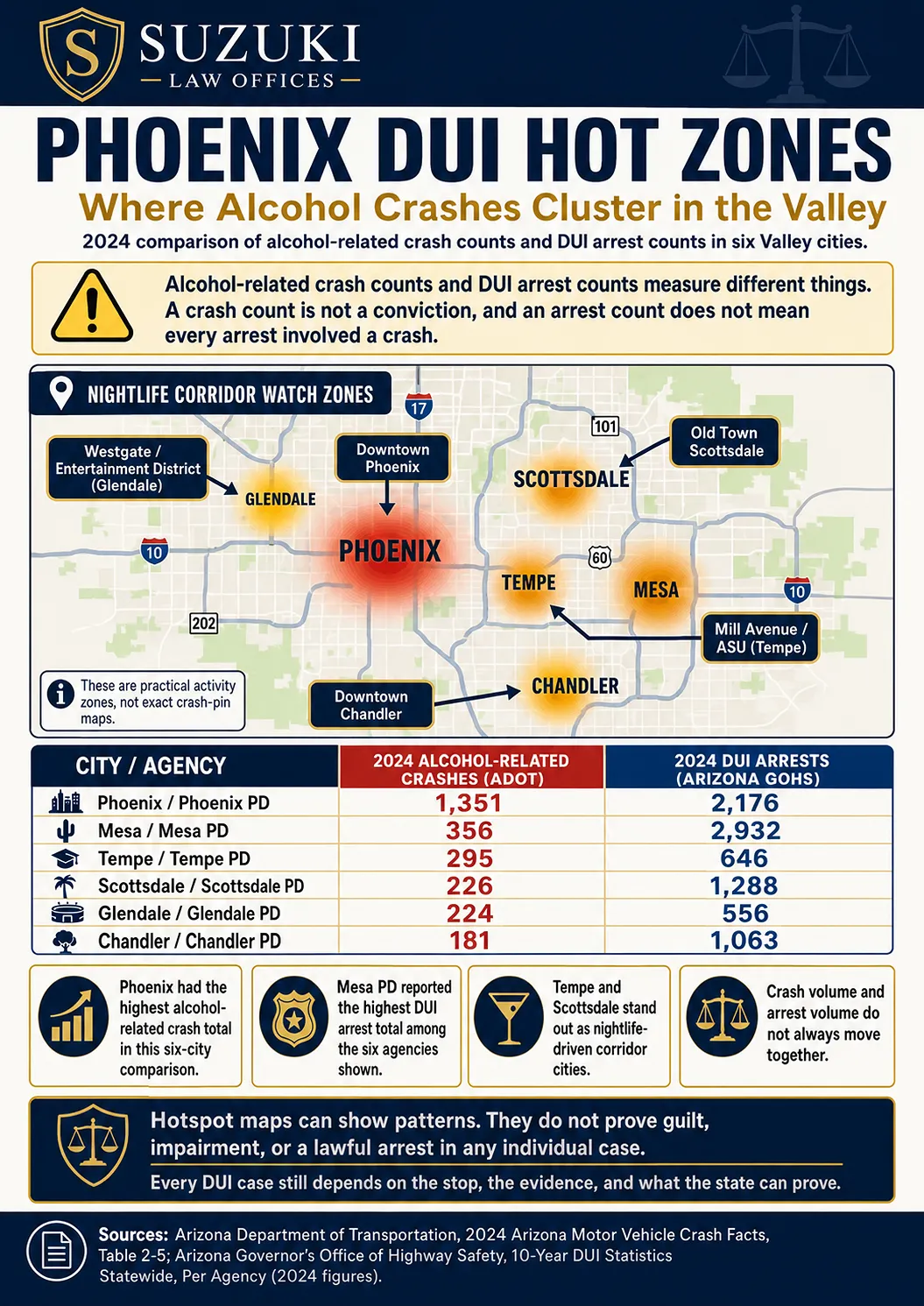
2024 Valley Alcohol-Related Crash and DUI Arrest Data
Six Valley cities were included in the review: Phoenix, Mesa, Tempe, Scottsdale, Glendale, and Chandler. ADOT’s 2024 Motor Vehicle Crash Facts report provided the alcohol-related crash totals, and agency arrest data came from the Arizona Governor’s Office of Highway Safety.
| Selected Jurisdiction | 2024 alcohol-related crashes reported by ADOT | 2024 DUI arrests reported |
| Phoenix / Phoenix PD | 1,351 | 2,176 |
| Mesa / Mesa PD | 356 | 2,932 |
| Tempe / Tempe PD | 295 | 646 |
| Scottsdale / Scottsdale PD | 226 | 1,288 |
| Glendale / Glendale PD | 224 | 556 |
| Chandler / Chandler PD | 181 | 1,063 |
Phoenix led the six cities with 1,351 alcohol-related crashes, while Mesa PD reported the highest number of DUI arrests at 2,932. The difference between those rankings shows why crash volume and arrest activity do not always follow the same pattern.
A city with more drivers, heavier traffic, major freeway connections, and a busy nightlife scene will generally have more opportunities for alcohol-related crashes to occur. DUI arrests are influenced more directly by how a police department covers its jurisdiction and approaches traffic enforcement. Neither number reveals much about a particular arrest, which must be evaluated using the evidence from that case.
Phoenix Had the Highest Alcohol-Related Crash Total
Phoenix’s position at the top of the six-city comparison reflects the scale and variety of traffic moving through the city each day. As the region’s largest city, Phoenix handles a broad mix of commuter traffic, nightlife, sporting events, concerts, freeway travel, and everyday trips between neighborhoods.
Several sources of late-night traffic overlap throughout the city:
- Downtown Phoenix entertainment traffic
- Roosevelt Row and central Phoenix nightlife
- Events near arenas and stadiums
- Connections to I-10, I-17, SR 51, Loop 202, and US 60
- Travel near Phoenix Sky Harbor International Airport
- Rideshare pickup and drop-off activity
- Late-night traffic associated with restaurants, bars, and event venues
A DUI investigation may begin after an alleged lane violation, speeding, a missed signal, an equipment problem, a collision, or a welfare check. When a stop occurs late at night near an entertainment district, an officer may also begin looking for indications that the driver has consumed alcohol or may be impaired.
Phoenix may sit at the top of the citywide crash rankings, but that number has little bearing on the strength of a particular DUI case. What matters is why the driver was stopped, what the officer saw, whether the body camera footage supports the report, how any breath or blood sample was handled, and whether the available evidence supports the charge.
Mesa Had the Highest DUI Arrest Total
Mesa stands out because its position in the arrest data is so different from its position in the crash data. The city recorded roughly one-quarter as many alcohol-related crashes as Phoenix, yet Mesa PD reported 756 more DUI arrests than Phoenix PD.
That gap reinforces an important distinction in the data: a DUI arrest does not have to follow a collision. Many investigations begin with a traffic stop or another encounter in which an officer suspects that a driver may be impaired.
Mesa’s annual arrest numbers say little about the evidence against a particular driver. A Mesa DUI lawyer can look closely at why the stop occurred, what happened during the roadside exercises, and whether an injury or balance problem may have affected the officer’s conclusions. The review may also include breath or blood testing records, available video, and any differences between the footage and the written report.

Tempe and Scottsdale Form a Core Nightlife Corridor
Tempe and Scottsdale had lower alcohol-related crash totals than Phoenix, but both remain important to the Valley’s late-night traffic patterns. Tempe is home to Mill Avenue and the ASU district, while Old Town Scottsdale draws people to its restaurants, bars, clubs, hotels, and event venues. Scottsdale PD also reported nearly twice as many DUI arrests as Tempe PD despite Scottsdale recording fewer alcohol-related crashes.
Together with central Phoenix, the two cities form a nightlife corridor that includes:
- Downtown Phoenix and central Phoenix entertainment areas
- Mill Avenue and the ASU district in Tempe
- Old Town Scottsdale
- Major routes connecting Phoenix, Tempe, and Scottsdale
A night out in the Valley does not always stay within one city. Someone may have dinner in downtown Phoenix, meet friends in Tempe, and travel through Scottsdale on the way home. With apartments, campuses, hotels, and rideshare areas spread across these districts, a driver may leave one city and be stopped in another.
The location and time of a stop may influence the questions an officer asks and whether the encounter develops into a DUI investigation.
A driver leaving Old Town Scottsdale, Mill Avenue, or downtown Phoenix may be questioned about alcohol consumption even when the original stop involved a relatively minor traffic allegation. Those circumstances may explain the officer’s attention, but the evidence from the individual stop must still support the charge.

Glendale and Chandler Add to the Valley’s Late-Night Traffic
Glendale and Chandler had lower alcohol-related crash totals than the other cities in the comparison, but both contain entertainment areas that draw evening traffic. In Glendale, Westgate brings together sporting events, concerts, restaurants, hotels, and nightlife, with drivers arriving from throughout the West Valley and beyond.
Downtown Chandler and the city’s surrounding restaurant corridors create another center of late-night activity in the southeast Valley. Chandler PD reported nearly twice as many DUI arrests as Glendale PD despite Chandler having the lower alcohol-related crash total, making it another notable point in the six-city comparison.
Trips from Westgate and downtown Chandler frequently extend into surrounding communities, including Phoenix, Peoria, Gilbert, Mesa, and Tempe.
Although Glendale and Chandler fall lower in the crash rankings, activity around their entertainment districts and the arrests reported by their police departments add another dimension to late-night DUI enforcement in the Valley.

Statewide DUI Timing Adds Context
Most of Arizona’s 5,520 alcohol-related crashes in 2024 occurred during nighttime hours, and more than half fell within ADOT’s defined weekend period.
| 2024 statewide timing | Alcohol–related crashes | ADOT definition |
| Nighttime | 3,947 (71.5%) | 6:00 p.m. to 5:59 a.m. |
| Weekend | 3,015 (54.6%) | 6:00 p.m. Friday to 5:59 a.m. Monday |
Those figures provide additional context for the Valley’s nightlife and entertainment corridors, where drivers often travel between restaurants, bars, concerts, sporting events, hotels, and nearby communities. Officers working during these hours may also be more alert to possible signs of impairment, particularly after observing an alleged traffic violation or responding to a collision.
The time and location of a stop may influence how an investigation develops, but driving late at night or leaving an entertainment district does not establish impairment. When a stop leads to a DUI charge, the more important questions include:
- What was the legal basis for the initial stop?
- Did the officer extend the stop based on observations that supported a DUI investigation?
- How were roadside field sobriety exercises explained and administered?
- Could an injury, fatigue, anxiety, or a medical condition have affected the driver’s performance?
- Were breath or blood samples collected and tested properly?
- Do the laboratory records support the reported result?
- Is the officer’s written account consistent with available video?
- Can the prosecution prove the specific DUI charge?
These case-specific questions carry more weight than the driver’s proximity to Mill Avenue, Old Town Scottsdale, Westgate, downtown Phoenix, or another entertainment area.
What the Phoenix DUI Hot Zone Map Means for Drivers
The Valley’s nightlife corridors see considerable travel between entertainment districts and surrounding communities, particularly during the nighttime and weekend periods when most alcohol-related crashes occur. If alcohol will be part of the evening, transportation should be arranged before the night begins rather than after it is time to leave.
Some of the most common trips from Valley entertainment areas cover relatively short distances:
- Old Town Scottsdale to south Scottsdale or Tempe
- Mill Avenue to north Tempe or Mesa
- Downtown Phoenix to Arcadia, Glendale, or Chandler
- Westgate to Peoria, Phoenix, or north Glendale
- Downtown Chandler to Gilbert, Mesa, or Ahwatukee
- Downtown Mesa to Tempe or east Phoenix
Drivers may underestimate the risk of getting behind the wheel when home is only a few miles away. Even on a short trip, an alleged wide turn, speeding, lane movement, rolling stop, equipment problem, or minor collision can lead an officer to investigate possible impairment.
What the Phoenix DUI Hot Zone Map Means for a Defense Case
For someone arrested in one of these areas, the map provides geographic context but does not answer the legal questions raised by the individual case. A DUI defense requires a close review of the stop, the investigation, the testing process, and the evidence the prosecution intends to use.
Depending on the circumstances, a defense attorney may examine:
- The legal basis for the traffic stop
- Whether the stop was extended beyond its original purpose
- The officer’s observations before and after speaking with the driver
- Body camera and dash camera footage
- Instructions given during roadside field sobriety exercises
- Breath-testing equipment records and test administration
- The timing of a blood draw and the chain of custody
- Laboratory procedures and toxicology records
- Evidence of impairment or a prohibited alcohol concentration
- Whether the person was driving or in actual physical control of the vehicle
- Whether the prosecution can prove every element beyond a reasonable doubt
The circumstances surrounding a collision may require additional scrutiny. A driver who has just been in a crash may appear shaken, confused, unsteady, dizzy, emotional, or in pain, and injuries may affect the person’s ability to follow instructions or perform roadside exercises. Those observations need to be considered alongside medical information, video footage, chemical testing, and the conditions at the scene.
A city’s crash ranking, an agency’s arrest total, or the location of the investigation does not establish guilt. The outcome of a DUI case depends on the admissible evidence and whether it proves the specific charge beyond a reasonable doubt.
Discuss Your Case With a Phoenix DUI Lawyer
The 2024 crash and arrest figures do not produce the same rankings across the Valley. Looking at Phoenix, Mesa, Tempe, Scottsdale, Glendale, and Chandler together reveals how differently crash volume, police activity, and late-night travel can appear from one city to the next.
Once someone is arrested for DUI, the regional numbers have little to say about the strength of the charge. That depends on the legal basis for the stop, what the officer observed, what body camera footage shows, how breath or blood evidence was processed, and whether the police report is consistent with the other records.
A Phoenix DUI lawyer at Suzuki Law Offices can review the circumstances of your arrest and explain what legal issues may apply.
The firm represents people facing DUI and other criminal charges in Phoenix and throughout the surrounding Valley. Contact Suzuki Law Offices to discuss your case and learn more about your options.
Call or text (602) 682-5270 or complete a Free Case Evaluation form