

Is There a Difference Between Voluntary and Involuntary Manslaughter?
There is a difference between voluntary and involuntary manslaughter. The primary difference between voluntary and involuntary manslaughter is the awareness and intention behind the offense. These two types of charges are also penalized differently.
If you are facing either type of charge, contacting a Phoenix murder and manslaughter lawyer as soon as possible is critical to your defense.
What Is Involuntary Manslaughter in Arizona?
Arizona does not use “involuntary manslaughter” as a separate statutory offense. In Arizona, an unintentional killing is usually charged as manslaughter if the death was caused recklessly, or negligent homicide if the death was caused by criminal negligence.
Under Arizona law, manslaughter includes recklessly causing the death of another person, while negligent homicide applies when a person causes a death through criminal negligence. Suzuki Law Offices criminal defense lawyers have the advantage of being former prosecutors and know how to fight the charges.
When Can an Unintentional Death Lead to a Manslaughter Charge in Arizona?
A person can face a manslaughter charge in Arizona when prosecutors believe the person was aware of a substantial and unjustifiable risk and consciously ignored it, and that conduct caused someone’s death. Arizona defines this mental state as recklessness. A criminal defense lawyer at Suzuki Law Offices uses experience and strategy to identify weaknesses in the state’s case.

What Is the Difference Between Manslaughter and Negligent Homicide in Arizona?
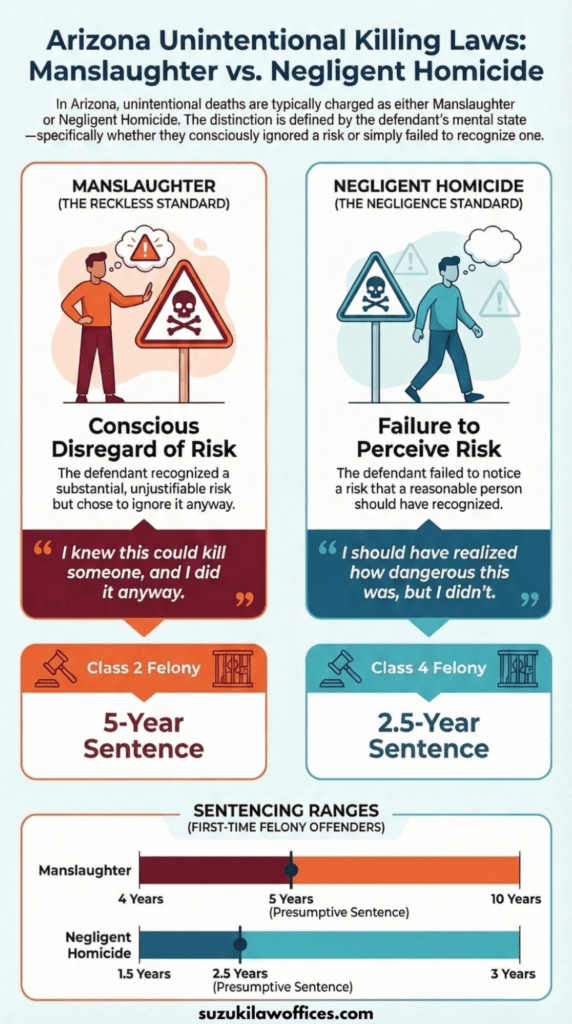
The difference usually comes down to the defendant’s mental state. Manslaughter applies when a person recklessly causes a death. Negligent homicide applies when a person causes a death through criminal negligence, meaning the person failed to recognize a substantial and unjustifiable risk that a reasonable person would have noticed.
At Suzuki Law Offices, our experience as prosecutors at the state and federal level gives us a deep understanding of how criminal cases are charged. We have an office located in Phoenix, the state capital of Arizona.

| Issue | Manslaughter in Arizona | Negligent Homicide in Arizona |
|---|---|---|
| Core rule | Causing another person’s death recklessly. | Causing another person’s death with criminal negligence. |
| Mental state | The person knew about a substantial and unjustifiable risk and consciously ignored it. | The person failed to notice a substantial and unjustifiable risk that should have been recognized. |
| Level of blame | Higher, because the person is aware of the danger and goes forward anyway. That is why Arizona treats it more severely. | Lower, because the person does not actually perceive the risk, even though failing to notice it is still a gross deviation from reasonable care. |
| Statutory wording | “A person commits manslaughter” by, among other things, “recklessly causing the death of another person.” | “A person commits negligent homicide” if “with criminal negligence the person causes the death of another person.” |
| What prosecutors usually must show | That the defendant recognized the serious risk and chose to disregard it, and that this caused the death. | That the defendant should have recognized the serious risk, failed to do so, and that this caused the death. |
| Felony level | Class 2 felony. | Class 4 felony. |
| First-time felony sentencing range | For a first felony offense, a class 2 felony carries 3 years mitigated, 4 years minimum, 5 years presumptive, 10 years maximum, and 12.5 years aggravated. | For a first felony offense, a class 4 felony carries 1 year mitigated, 1.5 years minimum, 2.5 years presumptive, 3 years maximum, and 3.75 years aggravated. |
| Simple way to think about it | “I knew this could kill someone, and I did it anyway.” That is the rough legal idea behind recklessness. | “I should have realized how dangerous this was, but I didn’t.” That is the rough legal idea behind criminal negligence. |

What Does “Recklessly” Mean Under Arizona Law?
Arizona law says a person acts recklessly when they are aware of a substantial and unjustifiable risk and consciously disregard it. The risk must be serious enough that ignoring it is a gross deviation from how a reasonable person would act in the same situation.

What Does “Criminal Negligence” Mean Under Arizona Law?
A person acts with criminal negligence when they fail to perceive a substantial and unjustifiable risk that a result will occur, and that failure is a gross deviation from the standard of care a reasonable person would use in the same situation. That is the mental state tied to negligent homicide in Arizona. Your criminal defense lawyer at Suzuki Law Offices works with you to create a strategy for the best possible outcome.
What Are Common Examples of Arizona Manslaughter or Negligent Homicide Cases?
These charges can arise from conduct such as reckless driving, careless firearm handling, unsafe conduct around vulnerable people, or other acts that create a serious risk of death. The exact charge often turns on whether the facts show recklessness or criminal negligence under Arizona’s statutes. Suzuki Law Offices is dedicated to evaluating evidence and providing representation you can rely on.
What Are the Penalties for These Charges in Arizona?
In Arizona, manslaughter is a class 2 felony, and negligent homicide is a class 4 felony. For a first-time felony offender, the sentencing range for a class 2 felony is 3 to 12.5 years, with a 5-year presumptive sentence. For a class 4 felony, the range is 1 to 3.75 years, with a 2.5-year presumptive sentence. Sentencing can vary based on aggravating and mitigating factors, prior convictions, and whether the offense is deemed dangerous.
What Defenses May Apply in an Arizona Unintentional Killing Case?
The defense will depend on the facts, though common arguments may include that the defendant did not act recklessly, did not act with criminal negligence, or did not cause the death. In some cases, Arizona’s justification laws, including self-defense, may also apply if the use of force was legally justified. Suzuki Law Offices examines cases from all angles to provide the best defense strategy.
Does Arizona Treat This the Same as Voluntary Manslaughter?
Not exactly. Arizona’s manslaughter statute covers more than one kind of conduct. It includes recklessly causing a death, but it also includes certain killings committed in a sudden quarrel or heat of passion after adequate provocation. That means Arizona groups several different fact patterns under the same manslaughter statute.
Arizona Manslaughter and Negligent Homicide Offenses are Penalized Differently
While manslaughter (A.R.S. 13-1103) and negligent homicide (A.R.S. 13-1102) are both felony charges, they are categorized differently due to the distinctions mentioned above. As the more serious offense, manslaughter is classified as a class 2 felony, while negligent homicide is considered a class 4 felony. Because of their classifications, both types of cases are handled and penalized differently in Arizona.
According to Arizona’s sentencing guidelines (A.R.S. 13-702), manslaughter charges can result in between 3 years and 12 and a half years in prison if convicted. The duration of the offense depends on whether mitigating or aggravating factors are present, the severity of the crime, and the specific circumstances. Judges weigh all the information and evidence before issuing a sentence.
As the lesser charge, negligent homicide can receive anywhere from 1 year to 3 years and 9 months in prison if convicted. Again, sentencing can vary depending on the factors involved in the case. Note that the sentencing terms mentioned here apply primarily to first-time offenders. If an individual has an existing criminal record, the terms of their sentence may be increased accordingly.
How Manslaughter and Negligent Homicide Cases Are Handled
Because manslaughter and negligent homicide are classified differently, they are handled differently throughout the legal process. This includes how these two offenses are prosecuted, the evidence used, the defense strategies employed, and the sentencing approach. To understand what to expect during your case, it’s important to understand the way these cases are prosecuted.
For manslaughter charges, prosecutors must demonstrate the offender’s reckless actions and disregard for the inherent risk to others. They’ll use evidence to demonstrate the offender’s actions and state of mind at the time. For negligent homicide, prosecutors must show the offender was negligent and should have reasonably been aware of the risks of their actions. Prosecutors must also establish a lack of intent.
Prosecutors will use a variety of evidence to make their case, which they must submit into discovery during the trial process. Your lawyer will review the evidence to understand the case against you and use that information to build a strong case. The way these cases are prosecuted has a strong bearing on what defense strategies your criminal defense lawyer will use to help you fight the charges against you.
Defense Strategies Can Vary Depending on Which Offense You are Charged With in Arizona
Manslaughter and negligent homicide have profound implications for your life. Beyond a loss of freedom, it also damages relationships, reputations, and the ability to reintegrate into society. As such, these charges require targeted defense strategies to secure a better outcome and mitigate their impact. While some strategies may be shared, they can also vary by charge.
Common defenses for manslaughter include self-defense, insufficient evidence, mistaken identity, defending others, having an alibi, lack of intent, violations of your legal rights, and more. Similarly, defenses used for negligent homicide may include lack of negligence, rights violations, the death was accidental, and insufficient cause. The case details and charge type can impact the defense used.
Regardless of which offense you are charged with, you need to know what evidence you can use in your criminal defense case to make it stronger and get the most favorable results. Your lawyer can use both physical and digital evidence, documentation, contextual aids, and witness and expert testimonies. They also challenge the prosecution’s evidence against you, especially if it was mishandled during the case.
Aggravating and Mitigating Factors May Apply to These Offenses
While defense strategies may differ between manslaughter and negligent homicide, aggravating or mitigating factors can be used in both cases. These elements provide additional information that increases or decreases charges and sentencing based on certain actions or qualities exhibited during the offense or upon or after arrest.
What Are Common Examples of Arizona Manslaughter or Negligent Homicide Cases?
These charges can arise from conduct such as reckless driving, careless firearm handling, unsafe conduct around vulnerable people, or other acts that create a serious risk of death. The exact charge often turns on whether the facts show recklessness or criminal negligence under Arizona’s statutes. Suzuki Law Offices is dedicated to evaluating evidence and providing representation you can rely on.
Suzuki Law Offices Fights for You if You’ve Been Charged With Manslaughter or Negligent Homicide in Arizona
Regardless of whether you are facing voluntary or involuntary manslaughter charges, you need to speak with an experienced, skilled, and knowledgeable lawyer from Suzuki Law Offices.
Our team will carefully assess your case, aggressively defend you, and build a strong case that gets results. Schedule a free consultation with our team today to learn more about your legal options and how we can help you.
Call or text (602) 682-5270 or complete a Free Case Evaluation form