

What Is The Difference Between Robbery and Theft?
In Arizona, theft and robbery are not the same charge.
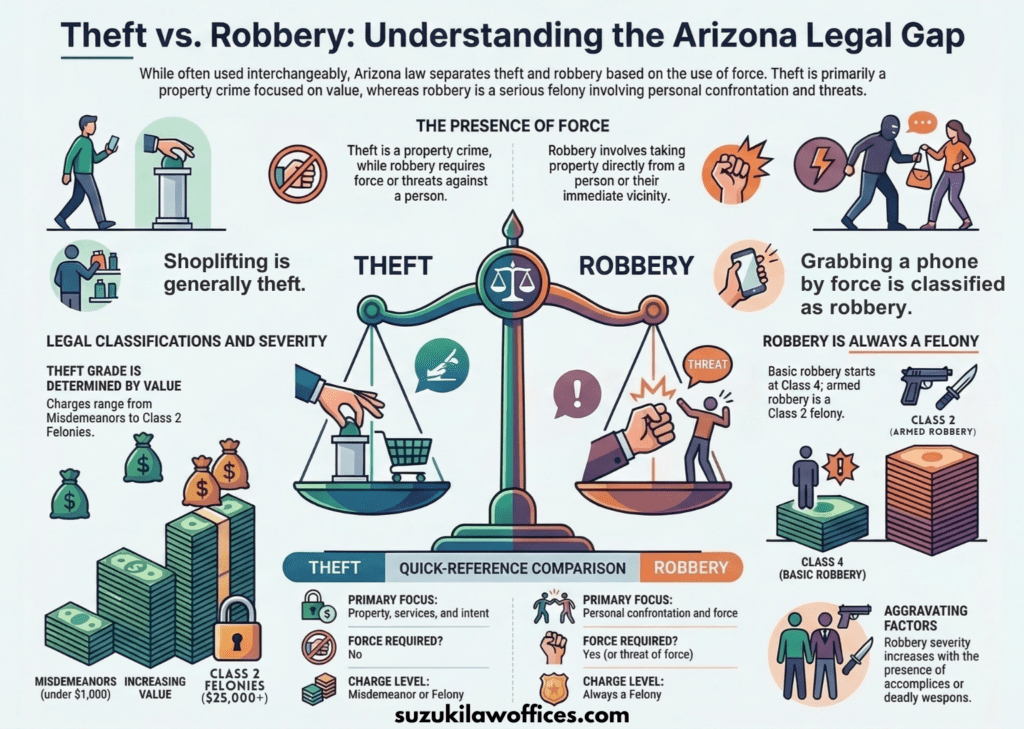
Theft is mainly a property crime. Robbery is a theft-related crime that involves the use of force or threats against a person. Under Arizona law, robbery happens when someone takes property from another person’s body or immediate presence, against that person’s will, and uses or threatens force to make it happen.
That difference matters right away. A theft case may turn on value, ownership, and intent. A robbery case brings in personal confrontation, which makes it a more serious offense. Suzuki Law Offices helps clients understand that the gap between these charges is not just in wording. It can change the level of the case, the penalties, and the defense strategy.
What Is Theft in Arizona?
Arizona’s theft statute covers more than simple stealing. A person may be charged with theft for knowingly controlling someone else’s property with the intent to deprive them of it, converting property or services that were entrusted to them, getting property or services through a material misrepresentation, keeping lost or misdelivered property without making reasonable efforts to find the owner, or controlling property while knowing or having reason to know it was stolen.
That means theft is not limited to shoplifting. It can include money, services, misdelivered property, and some forms of fraud-related conduct. Suzuki Law Offices can review what the State is actually alleging, because the word “theft” often hides a much more detailed accusation.
What Is Robbery in Arizona?
Robbery is a more direct crime against a person. Arizona defines robbery as taking property from another person or from that person’s immediate presence, against their will, while using or threatening force to make the person surrender the property or stop resisting. Robbery is a class 4 felony in Arizona.
Arizona also separates robbery into more serious forms. Aggravated robbery applies when the person committing the robbery is aided by one or more accomplices actually present, and it is a class 3 felony. Armed robbery applies when the person or an accomplice is armed with a deadly weapon or simulated deadly weapon, uses or threatens to use one, or takes or tries to take a deadly weapon during the robbery, and it is a class 2 felony.

Theft vs. Robbery at a Glance
| Issue | Theft | Robbery |
| Basic definition | Knowingly taking, controlling, converting, or obtaining another person’s property or services without lawful authority in one of the ways listed in Arizona’s theft statute. | Taking property from a person or that person’s immediate presence, against their will, by using or threatening force. |
| Is force required? | No. Theft does not require force or intimidation. | Yes. Force or threats are what turn the conduct into robbery. |
| Focus of the charge | Property, services, and intent to deprive. | Property plus confrontation with a person. |
| Where the property is taken from | Theft can involve many kinds of property situations, including property, services, misdelivered property, and stolen property. | The property must be taken from the person or immediate presence of another person. |
| Charge level | Theft can range from a class 1 misdemeanor to a class 2 felony, depending largely on value and some special categories. | Robbery is always a felony. Basic robbery is class 4, aggravated robbery is class 3, and armed robbery is class 2. |

Are the Charges Misdemeanor or Felony?
A theft charge does not always mean jail or prison exposure at the same level as robbery. Arizona grades theft by value, with theft under $1,000 generally treated as a class 1 misdemeanor, while higher-value theft can become a felony all the way up to a class 2 felony at $25,000 or more. Arizona also makes some lower-value theft conduct a class 6 felony, including theft taken from the person of another and theft of a firearm.
Robbery starts at the felony level because the law treats force or intimidation as a major step up in seriousness. That is one reason Suzuki Law Offices looks closely at witness accounts, surveillance, statements, and the exact sequence of events. In some cases, the fight is not over whether property was taken. The fight is over whether the evidence truly shows force, threat, or immediate presence.

A Simple Example: Theft vs. Robbery
If someone slips merchandise into a bag and walks out of a store without paying, that is usually theft or shoplifting, not robbery, because there is no force against a person.
If someone grabs a phone from another person’s hand and uses force or intimidation to stop that person from resisting, that is much closer to robbery under Arizona law because the taking is from the person or immediate presence and includes force or threats.

Theft vs. Robbery FAQs
Is robbery just a more serious kind of theft?
In a practical sense, yes. Robbery includes a theft-related taking, though Arizona adds a key extra element: force or threat of force against a person. That extra element is what makes robbery more serious.
Can theft be a felony in Arizona?
Yes. Theft can be charged as a misdemeanor or felony depending on the value of the property or services and the facts of the case. Theft under $1,000 is generally a class 1 misdemeanor, though some lower-value theft cases can still be charged as class 6 felonies.
Is robbery always a felony in Arizona?
Yes. Basic robbery is a class 4 felony. Aggravated robbery is a class 3 felony. Armed robbery is a class 2 felony.
Why talk to Suzuki Law Offices after a theft or robbery arrest?
Suzuki Law Offices brings trial experience, preparation, and real courtroom knowledge to criminal defense matters. That can matter early, especially when the case depends on intent, identification, force, or how the police built the charge.
Talk to Suzuki Law Offices About Theft or Robbery Charges
The line between theft and robbery can shape the entire case. A charge that sounds simple on paper may carry very different risks once Arizona’s statutes are applied. Suzuki Law Offices represents clients with a preparation-first approach and focuses on keeping clients informed while building a criminal defense around the facts that matter most.
Call or text (602) 682-5270 or complete a Free Case Evaluation form